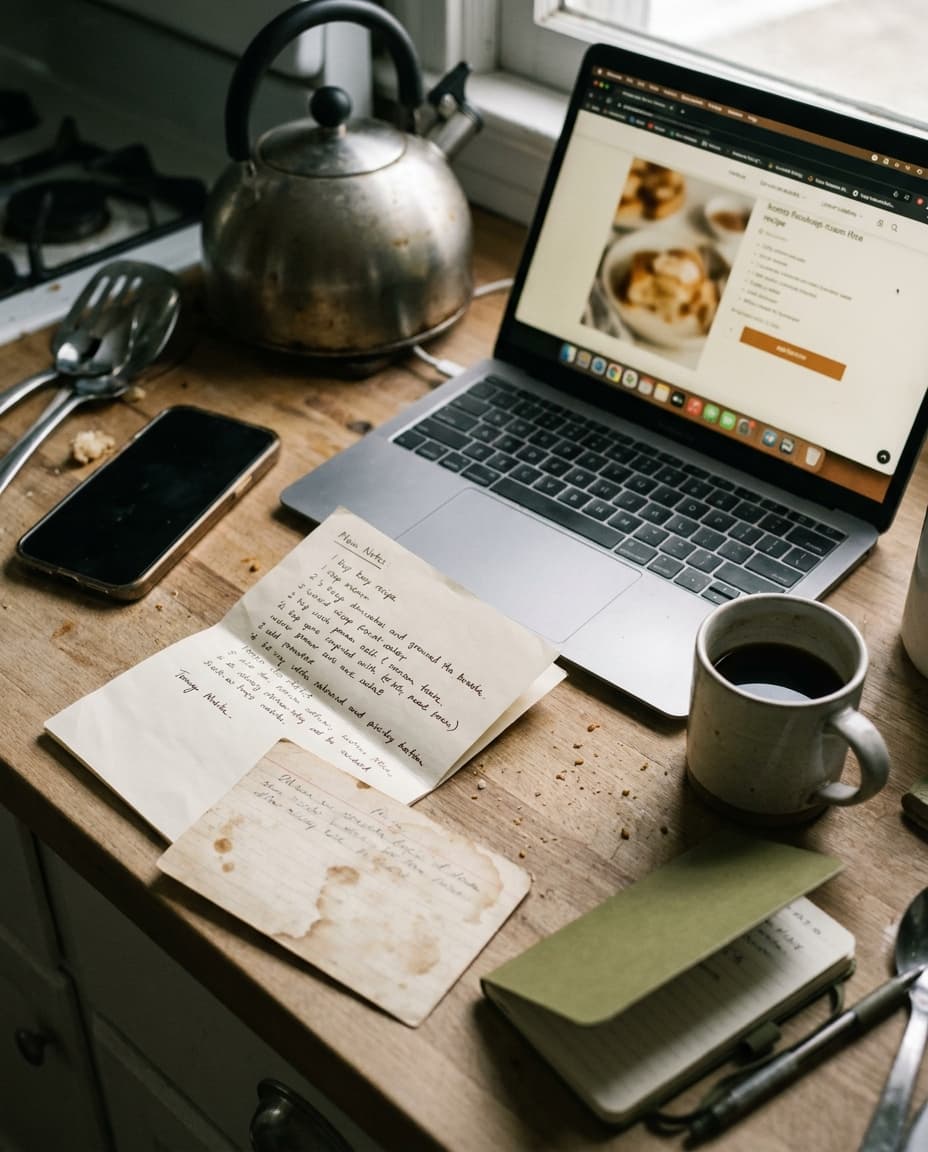
There is a screenshot, taken on a Tuesday evening in October of 2023, that we keep pinned to the wall above the desk. It shows a recipe website on a phone. The recipe is for a leek and potato soup. Above the recipe, before any ingredient is listed, the page contains: a 1,400-word essay about the author's grandmother, a video that autoplays, two newsletter pop-ups, a banner ad for a meal kit, an interstitial ad for car insurance, and a sticky bottom bar suggesting we install the website's app. The actual recipe is, by careful measurement, on the third scroll.
We built Basil because we got tired of cooking from that page.
§ I.An opinion, expressed in software.
Every app is an argument. The argument can be hidden, decorated, denied — but it is there, in every default, every menu, every absence. A social app argues that you should care what other people are doing. An optimisation app argues that the unmeasured life is a worse one. A recipe app, depending on who built it, argues a great many things — that you should buy more groceries, watch more videos, follow more chefs, share more meals, subscribe to more tiers.
The argument we wanted to make was much smaller. That a recipe is something you cook from, not something you scroll through. That the right unit is the dish, not the feed. That a person who has been cooking for twenty years deserves a tool that respects them, and a person who has been cooking for two months deserves the same one. That the kitchen is not, in the end, a content category.
§ II.The small frustrations that built it.
Most of the design of Basil came out of small, specific, repeated annoyances. The phone screen going dark while we had dough on our hands and could not tap. The recipe imported from a website that arrived with an ad still embedded in step three. The grocery list that lost its check marks every time we left the app. The unit conversions that made us do mental arithmetic with one wet hand. The seven seconds of loading before a recipe would open, every time, on the bus.
None of these are large problems. Together, they are the entire problem. A tool that fails on small things, a hundred times a week, is not a tool. It is a friction generator. The work of Basil has been, in large part, the work of removing the small frictions one at a time, in the order our own kitchens encountered them.
§ III.What we left out, on purpose.
Basil has no social feed. We considered one, briefly, and then we considered what a social feed would do to a recipe app, and we stopped considering. There is no follower count. There are no likes. There is no algorithm choosing which recipes to put in front of you. The recipes you see are the recipes you put there.
There are no ads. There are no pop-ups asking you to upgrade. There is no AI chef in the corner offering to rewrite your grandmother's cassoulet in a bro voice. There is a quiet, optional set of useful features behind a one-time purchase, which we will continue to refine, and which you can ignore entirely if you would rather. We are not interested in being the app you are nagged by. There are enough of those.
Most of what we left out is what makes the app feel like the app.
§ IV.The category that is still half-built.
Recipe apps are, depending on how you count, a thirty-year-old category. They have had every wave — the desktop years, the early iOS rush, the cloud-sync era, the subscription pivot, the AI moment. After all of this, most of the home cooks we know still keep their actual recipes in a Notes file, a screenshot folder, and a drawer. The category, by the only test that matters, has not yet succeeded.
We do not think the reason is technical. The technology has been adequate for a decade. The reason is one of stance. The category has been built, mostly, by people trying to monetise cooking, rather than by people trying to cook. The result is software that feels — and we say this with no joy — like a magazine pretending to be a tool. Basil is a tool that occasionally feels like a magazine, which is the inversion we wanted.
§ V.An invitation, not a campaign.
We are a small team. We work in a converted second bedroom in St. Petersburg, Florida, with one window that faces a live-oak tree, and a kitchen down the hall that is, more often than not, the test environment. We do not have a growth department. We do not have a content strategist. We have, instead, a long list of small things we want to fix, and a slowly growing number of cooks who have moved their recipes onto our shelf and stayed.
If you are tired of the recipe page that asks for your email before it will give you a soup, Basil is for you. If you are content with what you have, Basil is also fine without you. There is no urgency to this announcement, and no campaign behind it. We will keep building it the way we have been building it, slowly, on Tuesdays, in between dinners.
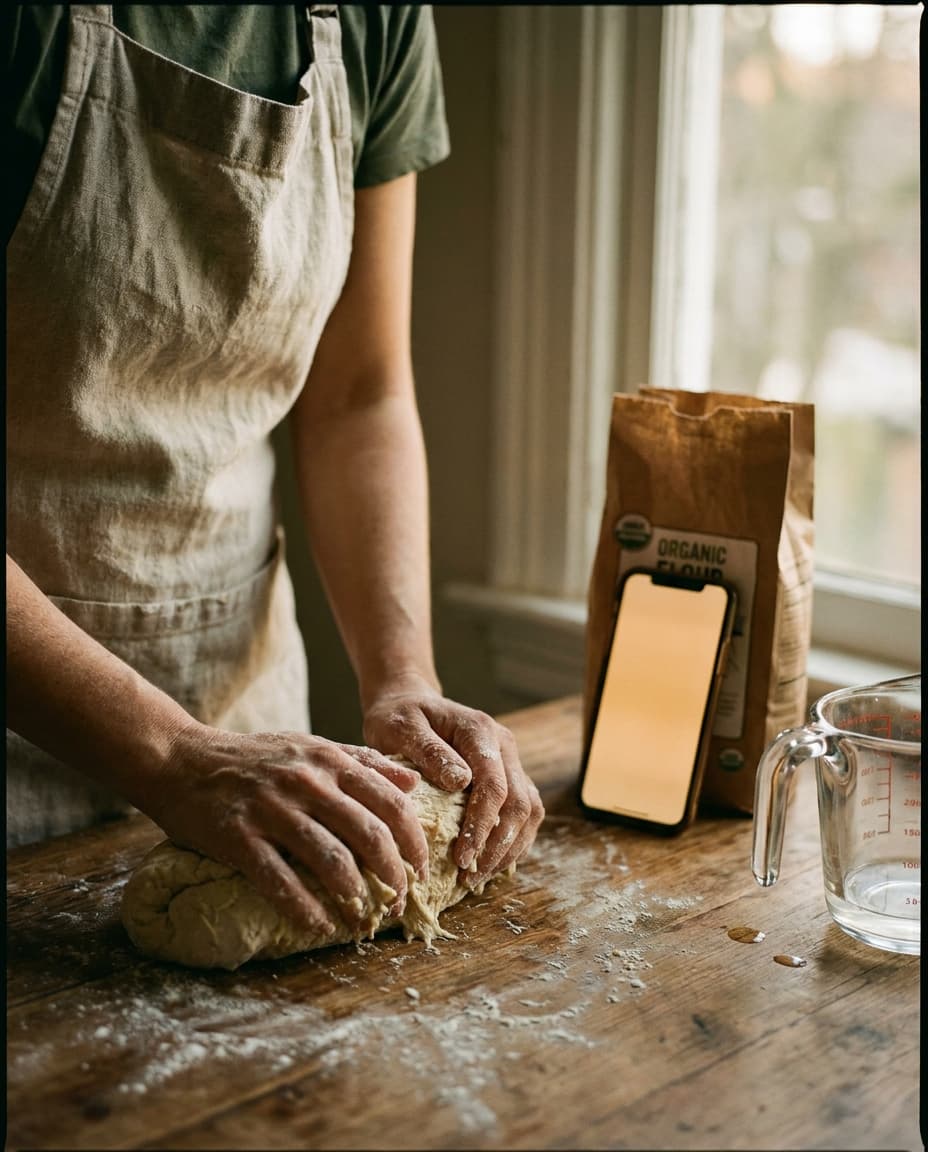
The screenshot is still on the wall. Below it, on a different scrap of paper, is a photograph from last week — a phone propped against a flour bag, a cooking-mode screen showing a brioche recipe, two hands in dough beyond the frame. The screen is awake. The page is the recipe. There are no ads, no pop-ups, no autoplay. This is the argument. We thought it was worth making in software.