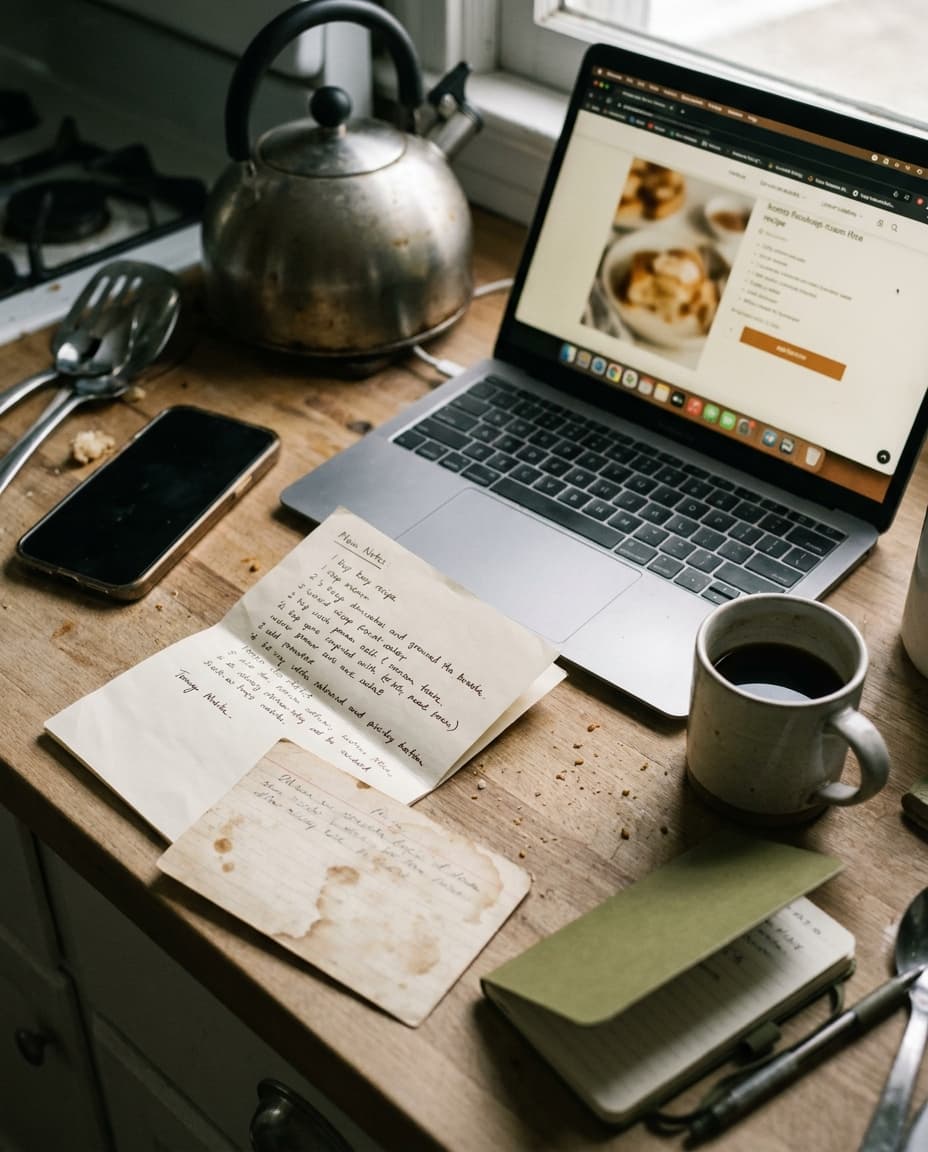
Last Thursday, I wanted to make milanesas. The way my grandmother made them, which is to say the way she had described them to my mother, who had described them to me, who had then asked her cousin in Rosario to send the actual recipe. What arrived, by the end of the week, was four documents from four different sources: a blog post in Spanish, a one-minute Instagram reel from a chef in Mendoza, a four-minute YouTube tutorial from a home cook in Córdoba, and a six-message text exchange with the cousin.
All four were, more or less, the same recipe. None of them were, exactly, the recipe. The cooking, when I finally got to it, was the easy part. The harder part was the work that came before — the work of getting four different formats into one place I could actually cook from.
§ I.The blog post — easy, almost a relic.
Recipe blogs, despite the perpetual rumors of their decline, remain the most well-behaved source on the modern internet. Most of them publish structured data behind the scenes — a small block of machine-readable text that lists ingredients, steps, yields, and times. Any recipe app worth using can read this directly. You paste the URL; the app does the rest.
The catch, in 2026, is that a non-trivial percentage of "recipe blog" traffic now lives on personal Substacks and small publication sites that don't bother with structured data. For these, the workflow is closer to the older one: copy the relevant section of text, paste it in, and clean up the formatting. Painful but manageable. The whole exercise rarely takes more than five minutes per recipe.
§ II.The Instagram reel — the modern problem.
Here is where the modern import problem actually lives. The reel for the milanesas was sixty seconds long, set to a song I did not recognize, and contained — between visual cuts — perhaps a dozen ingredients and six discrete steps. There was no caption with the recipe. The recipe, such as it was, had to be reconstructed from what the camera showed and what the chef said over the music.
Three approaches work. The first is to watch the reel three times with a notebook, pausing on each ingredient shot. Slow and reliable. The second is to look in the comments, where roughly one in three reels of any popularity will have a kind soul who has already transcribed the recipe in a pinned reply. The third — and the one I now use most — is to let an app with a parser do the work. The app pulls the audio, transcribes it, identifies the ingredients, and produces a draft recipe you then correct by hand. The correction is still real work. But it begins from something, rather than nothing.
§ III.The YouTube tutorial — timestamps are the trick.
The Córdoba video was four minutes long, and roughly the first fifty seconds were biographical preamble — how the cook had learned the recipe, where she had grown up, why this version was different from her aunt's. Useful to listen to once. Not useful to transcribe.
The trick with YouTube is to be ruthless about timestamps. Most videos of any length have an ingredients block early on (often from minute one to minute two) and a method block immediately after. Skip to those. If the video has chapters, even better — they are often more accurate than the description. Take notes from the ingredients section while paused. Then play the method section at one-and-a-quarter speed, taking notes as you go.
The same parsing apps that handle Instagram now handle YouTube — paste the URL, get a draft. The draft is rougher with video than with audio, but it is still a faster start than a blank page. I correct mine over a coffee, with the video open in a second window for the parts the transcription got wrong.
§ IV.Screenshots, texts, and the email from your aunt.
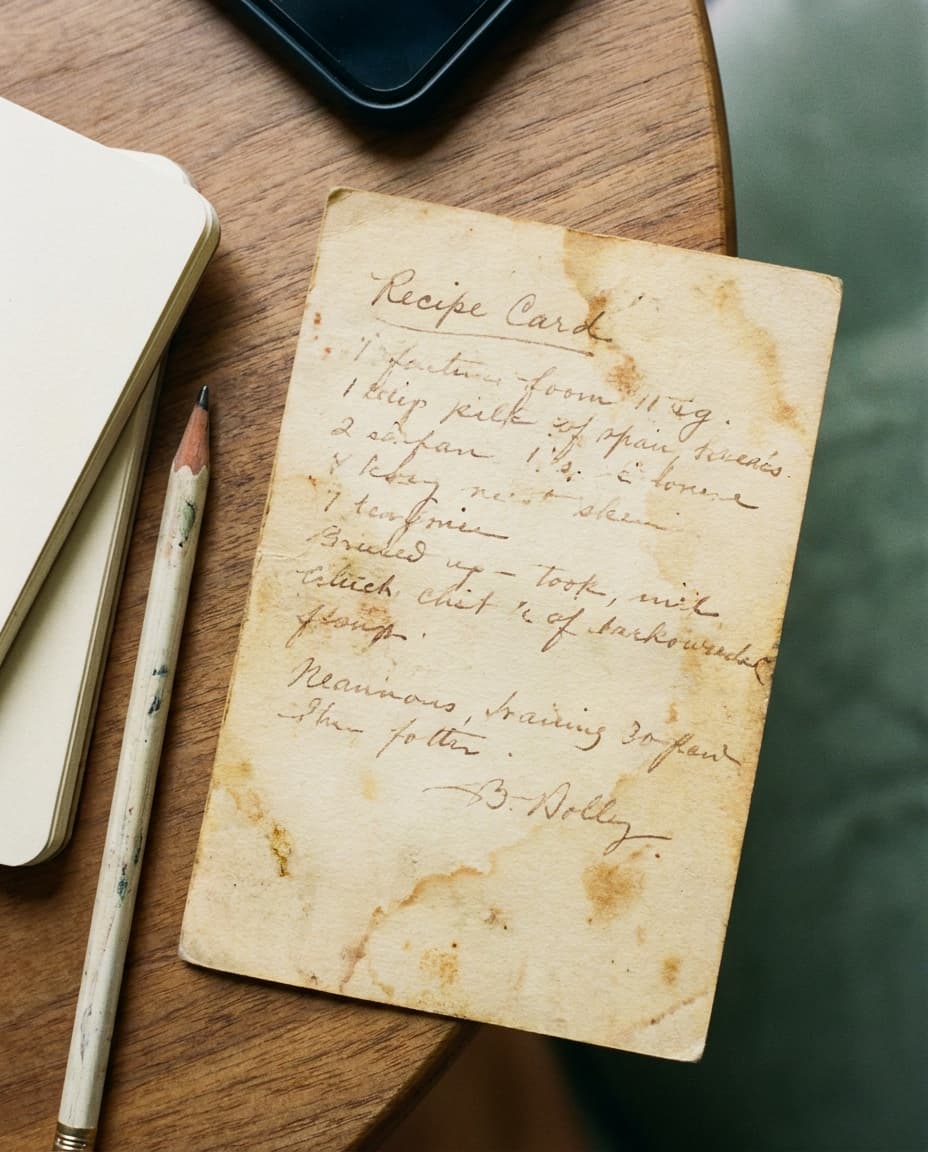
The remaining sources are the messy ones — and, often, the most loved. The screenshot a friend sent you of a screenshot they took of a magazine page in 2018. The six-message text exchange in which the recipe arrives in fragments. The email from your aunt with the subject line "the cake" and three paragraphs that include both the recipe and the news that your cousin has had a baby.
For screenshots, the modern OCR built into most phones works well enough for short recipes — long-press the image, copy the text, paste it into your recipe app, clean up. For longer screenshots or handwriting, a dedicated app does better. For text-message exchanges, manual entry is usually faster than any tool, because the recipe is interleaved with conversation that no parser can reliably untangle. For your aunt's email, the same — but save the original somewhere, because the parts that aren't the recipe are also part of the recipe.
Importing isn't the goal. Cooking is. Beware the beautiful library you never open.
Across all of these, what I look for in a tool is the same: paste a URL, paste a screenshot, paste a block of text — and have the app meet me wherever the recipe lives, rather than asking me to translate it into the format the app prefers. Basil handles URL imports across blogs, reels, videos, and screenshots in the same flow, which is what convinced me to consolidate three years of fragmented saves into one library. Other apps do this competently. The point is not the app. The point is that the import friction has to be near zero, or the library never gets built.
The milanesas, when I finally cooked them on Friday night, were excellent. The version I now have in my own library is, technically speaking, none of the four originals — it is a fifth version, assembled from the parts of each that I trusted, with my cousin's note about the egg wash and the chef's note about the breadcrumb thickness and a single line of my own at the bottom: "do not skip the second resting." That fifth version is the one I will cook from next time. The other four can stay where they are. The cook's job, in 2026, is consolidation.