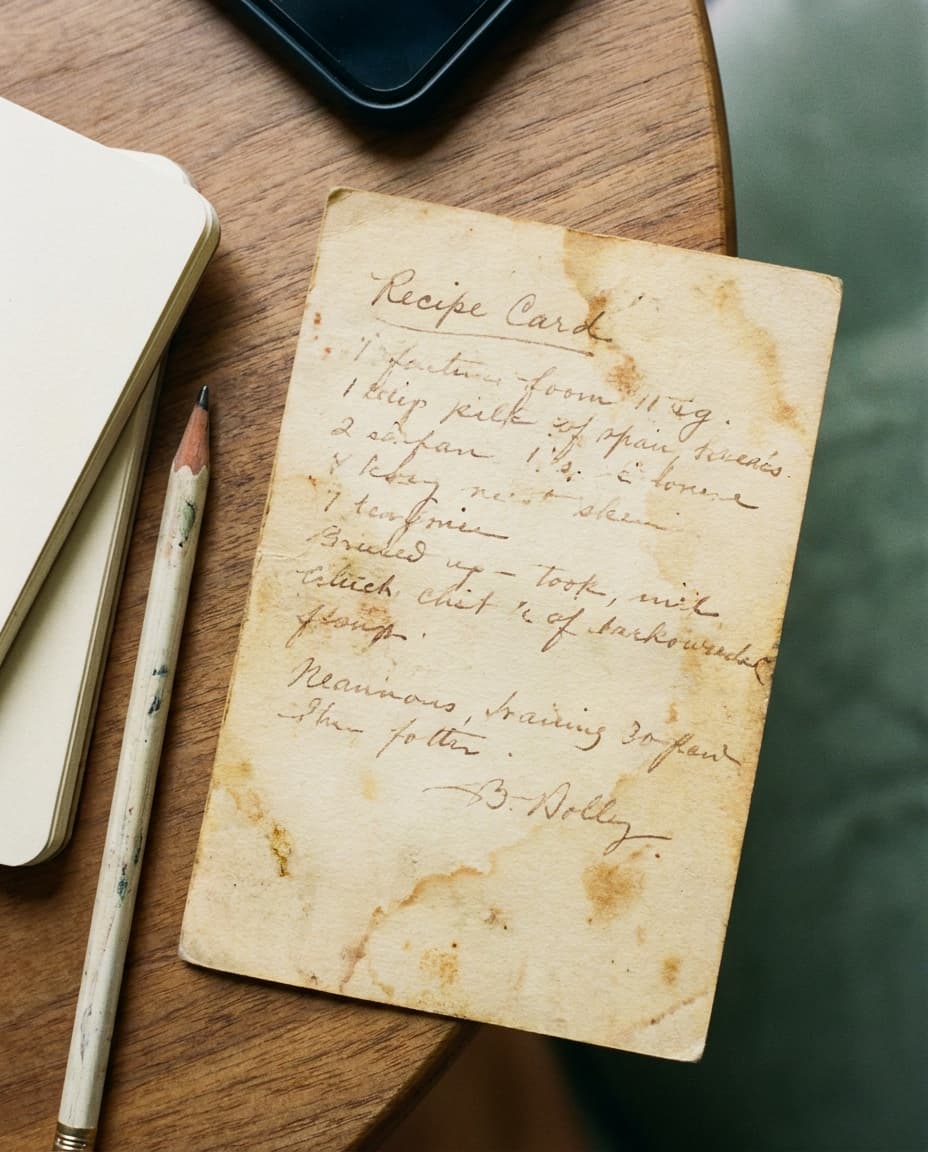
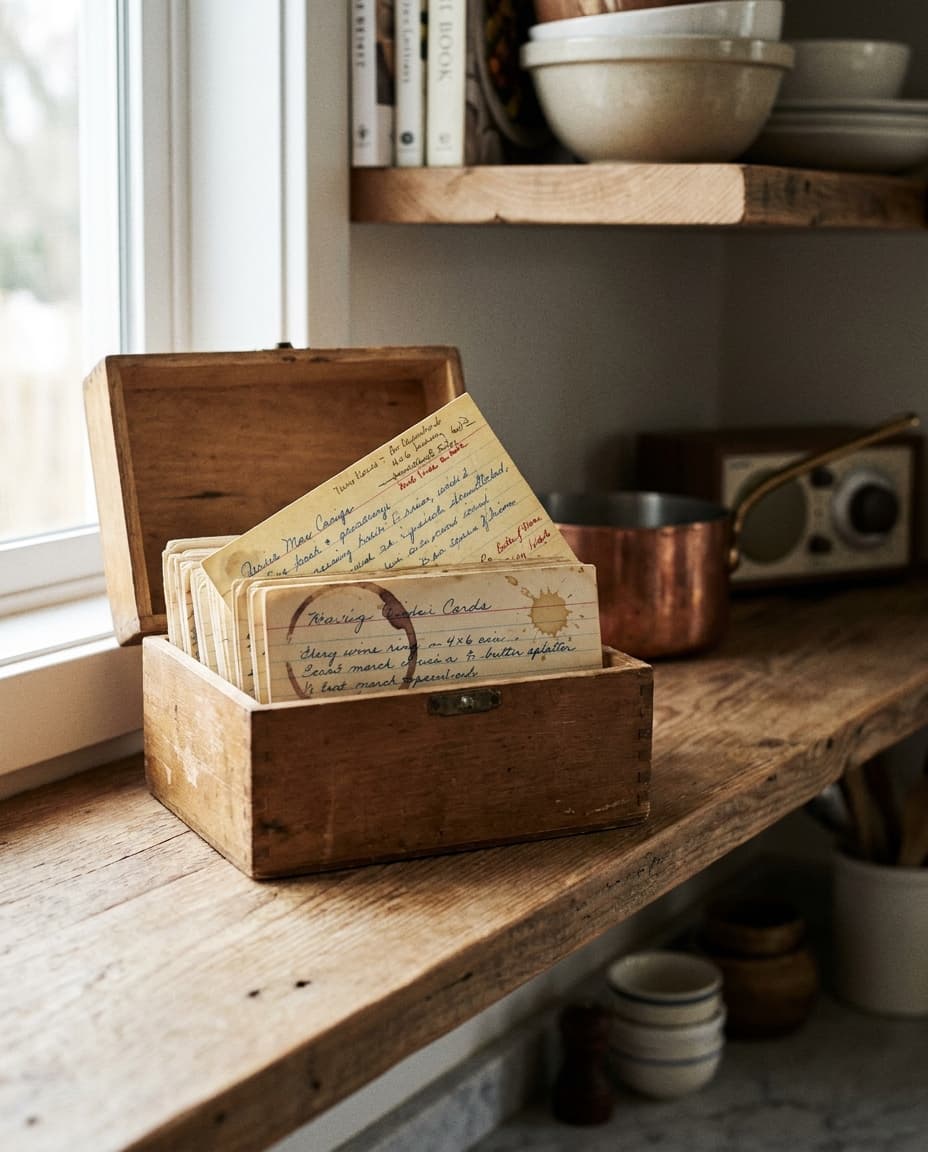
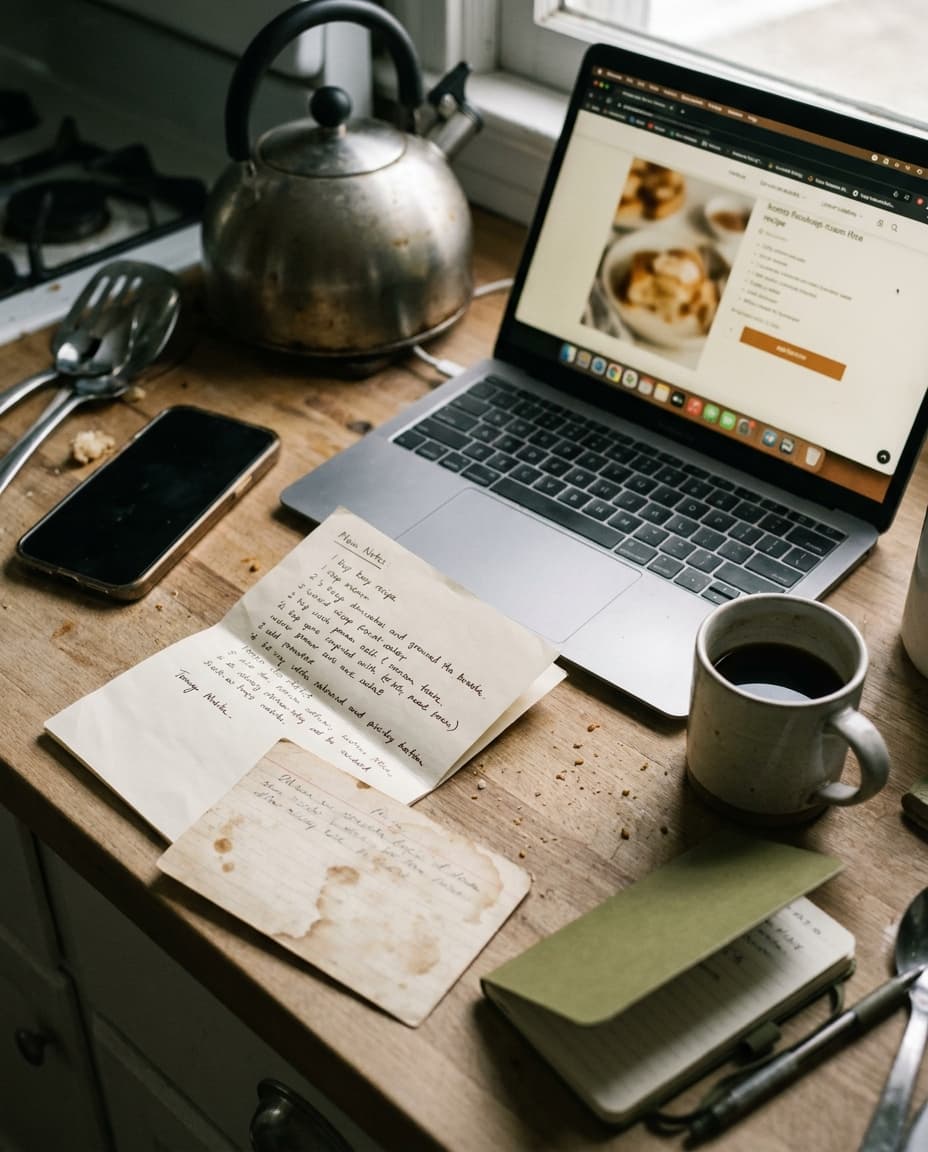
On the kitchen counter, on a Sunday morning, the inventory goes like this. A phone, screen-down beside the kettle, with seventeen unopened tabs in Safari and a Notes file titled, with no irony, recipes. A laptop, half-shut, displaying a half-loaded New York Times page about a leek tart. A printed sheet from 2019 — Lentils, Pierre — folded twice, the creases gone soft from handling. An index card in a drawer. A screenshot in the camera roll, taken in November, of a stranger's Instagram caption for a kind of stew.
I am about to make none of these. I am about to open the same browser and search, in good faith, for a recipe for lentils.
§ I.The library is invisible because it is everywhere.
The premise of every recipe app, every cookbook subscription, every newsletter pitched at home cooks, is that you do not have enough recipes. That what you need is more — better-curated, better-tested, better-photographed. The promise is always additive. Subscribe and we will give you twelve more dishes per month than you currently know how to make.
This premise is, on inspection, almost completely backward. The average home cook in 2026 has, at minimum, several hundred recipes already in some form of personal possession. They are simply distributed across nine or ten surfaces, none of which speak to each other, and most of which are not designed for retrieval. The library exists. It has not been catalogued, and it has not been admitted to.
If you doubt this, perform the exercise. Open the camera roll on your phone and search for the word menu. Then bookmarks. Then the Notes app. Then your saved Instagram folder. Then your email, for the term recipe. Then the printed pages stuffed into the cookbook on the shelf you actually use, which are, on inspection, mostly other people's recipes that you copied and never put away. The number you arrive at, even with conservative counting, will surprise you.
§ II.The cost of a scattered collection.
A library that cannot be searched is not a library. It is a hoard. The functional difference is that a library serves the present, and a hoard serves only the act of having collected. By that test, almost every home cook in possession of a smartphone is hoarding recipes — not cooking from them.
The cost is not abstract. It is the Tuesday evening when you stand in front of the open fridge with a half-bunch of dill and three eggs and reach, by reflex, for the search bar. Somewhere — you are sure — there is a recipe you saved, two years ago, that uses exactly this. You will not find it. You will instead read four new recipes, hate three, and cook the fourth, which is fine. The recipe you saved is still there, somewhere, waiting to not be found again next month.
§ III.The myth of the next great source.
There is a particular delusion, common to people who like to cook, that the problem is finding the right recipe. That somewhere, on some publication or substack or app, the better version of a roast chicken exists, and once it has been located, the cooking will follow. This is the same delusion as buying a ninth notebook to finally start journaling.
The recipes you will cook from for the rest of your life are, with high probability, already in your possession. The ones you have made twice and liked. The ones a friend texted you. The ones that have been in your mother's handwriting since you were nine. The seven or eight that you actually return to, unaided, when the question is what's for dinner.
A library that cannot be searched is not a library. It is a hoard.
§ IV.What consolidation actually looks like.
Consolidation is not a Sunday-afternoon project. It is not an afternoon at all. The fantasy of sitting down for three hours and migrating every recipe into one place is the same fantasy that ruins most attempts at it: too ambitious, too neat, abandoned by the second hour. The honest version is smaller and more boring. You move recipes when you cook them.
The next time you make the lentils — the ones from the printed sheet, Pierre's — you put them somewhere they can be found. The next time you reach for the saved Instagram caption about the stew, you transcribe the four lines into a place that knows it is a recipe and not a photograph. Over six months, the library you actually use — perhaps forty dishes — assembles itself. The other nine hundred can stay where they are. They were never going to be cooked.
§ V.The shelf.
What a person needs is not more recipes. What they need is a shelf — one place, with a search bar, that knows the difference between the lentils and the leek tart and the stew. A place that does not require you to remember, on a Tuesday evening with a half-bunch of dill in your hand, which app you used to save the thing. A place that, when you put a recipe on it, lets the recipe stay.
I keep mine in a small green app on my phone, and I will admit, with no marketing intent, that the green app is the one we make. The point is not the app. The point is the shelf. Any shelf. Pick one and start moving things onto it, slowly, only when you cook.
On the counter, on a Sunday morning, the inventory could go differently. A phone, with one app open, holding the forty dishes I actually make. A printed sheet from 2019, framed, because Pierre's lentils are now in the shelf and the paper is no longer load-bearing. A laptop, closed. The library was always there. It only needed to be admitted to.