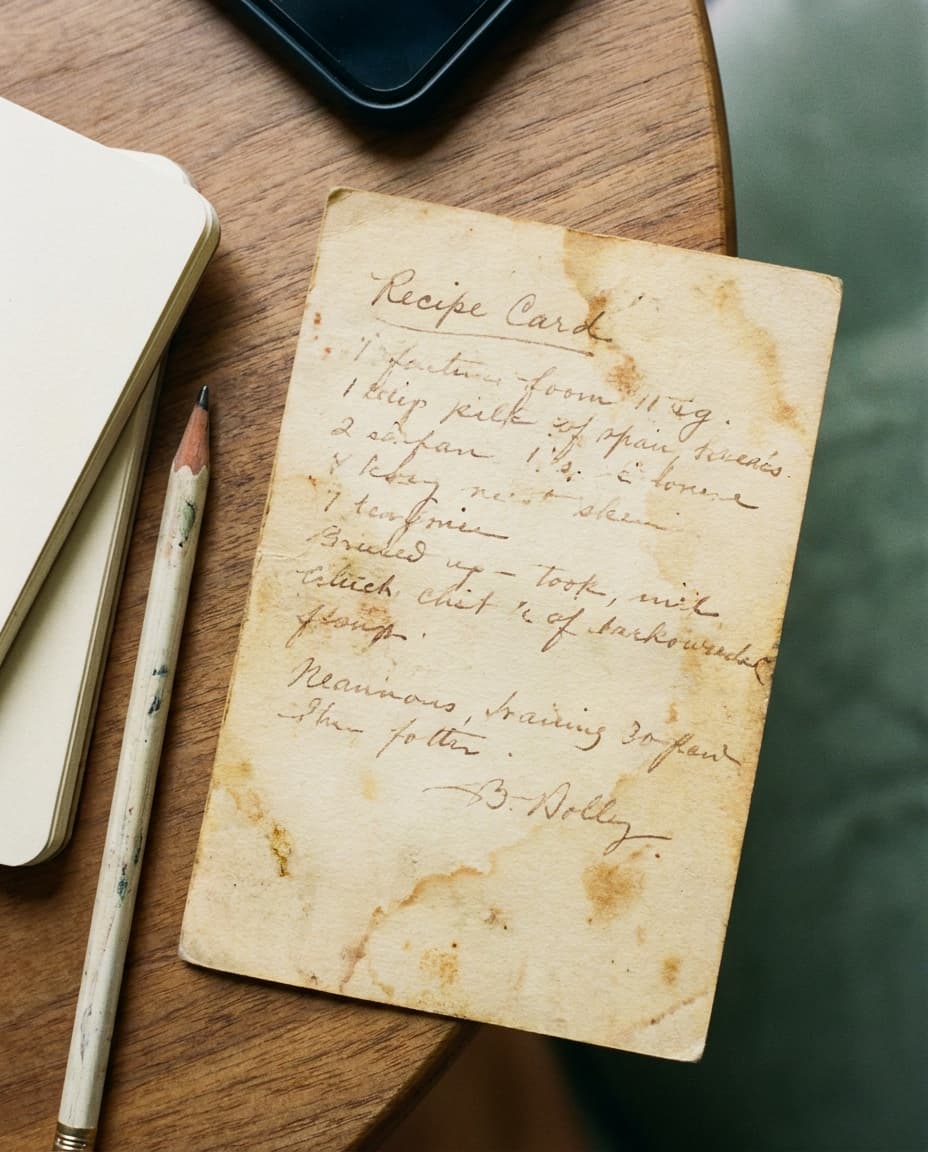
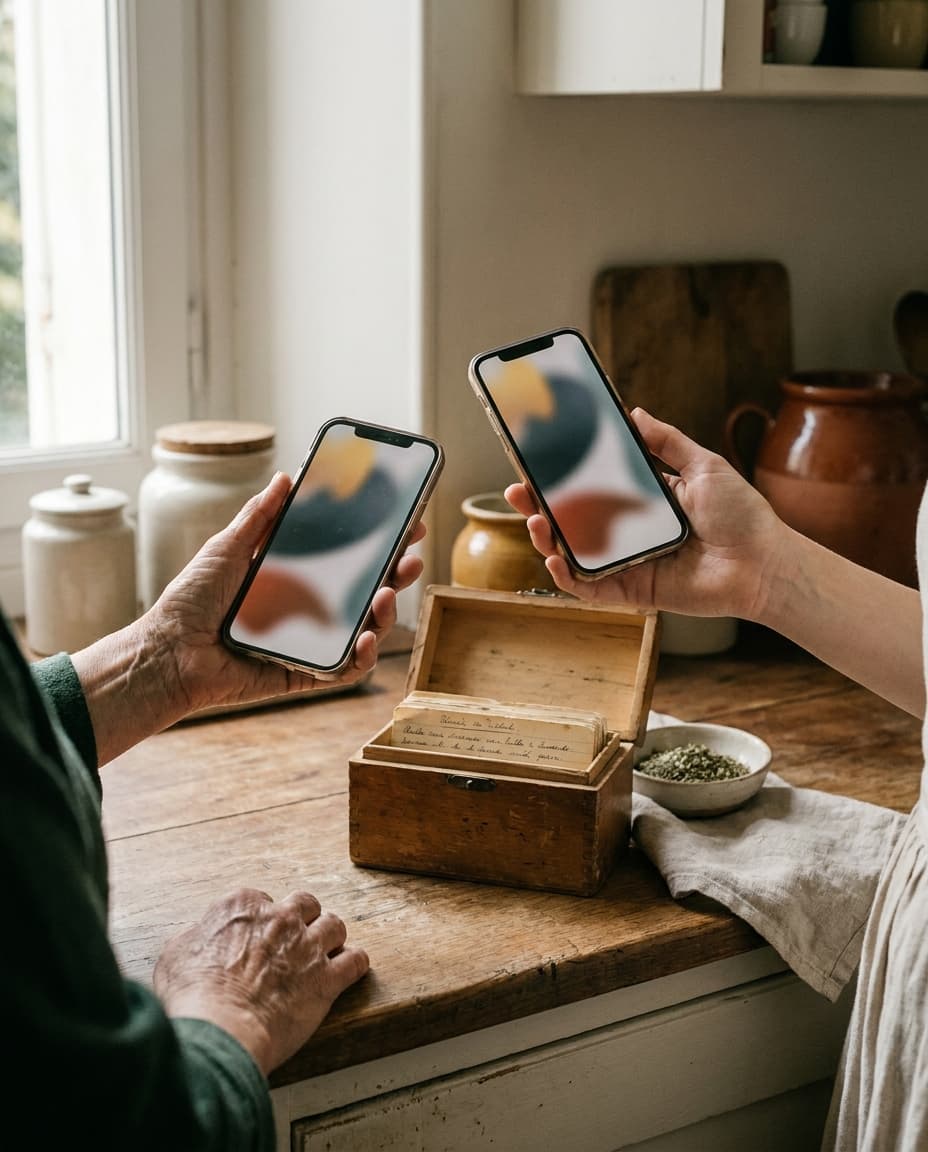
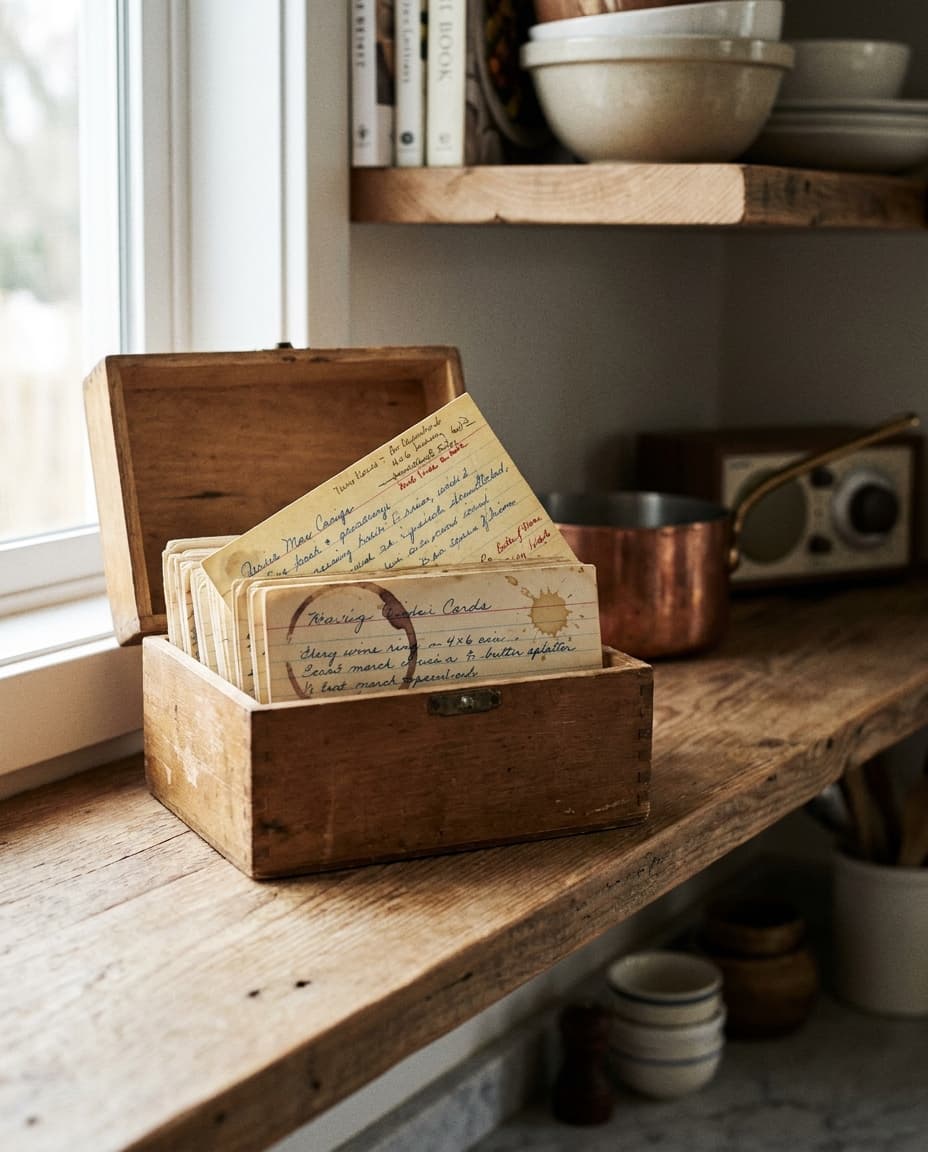
The box is wooden, the size of a half-loaf of bread, and it sits on the shelf above the radio in my kitchen. Inside are perhaps two hundred index cards, none of them sorted, all of them bearing the same kind of damage — a pale ring from the bottom of a wineglass, a translucent patch where butter once fell, an ink note in a hand that is not the hand of the original recipe, written in a different decade and a different colour, saying simply: less flour.
The card on top, this morning, is for a fennel gratin. It was first written in 1972 by my grandmother, in the careful upright hand she used for everything important. Below her version, in my mother's looser script: use Comté, not Gruyère. Below that, in my own — written four years ago, in pencil, because I was not yet certain — try with a little orange zest. Three women, three hands, fifty-four years. The card is the recipe and the record of the recipe being made.
§ I.The card was a different kind of object.
A recipe in a cookbook is a finished thing. It has been tested in someone else's kitchen, photographed, edited, copy-edited, and printed in a run of forty thousand. It arrives in your hands authoritative and unchangeable. You may, of course, scribble in the margin — and many people do — but the page resists the scribble. It was not designed to receive it.
An index card was designed for nothing else. The card existed to be written on, then written on again. It assumed, structurally, that the recipe would change — that the cook would learn something about the dish in the act of making it, and would want to add what they had learned. The marginalia was not a defacement of the recipe. The marginalia was the recipe, in its truest form, accruing.
§ II.What the splatters meant.
There is a particular sentimentality, available now mainly in greeting cards and food-magazine essays, about the grease stains on a grandmother's recipe card. The sentiment is real but lazy. It is not the stain that matters. It is what the stain is evidence of. A card that has been splattered eight times is a card that has been cooked from eight times. It is, plainly, a recipe that worked.
Cookbooks do not record this. A cookbook on your shelf, however beautiful, gives no information about which recipes you have actually made and which you have only intended to. Open any home cook's cookbook collection and you will find that perhaps four percent of the recipes have been cooked, and there is no way to know, by looking at the spines, which four percent. The card knew. The card kept score.
§ III.The marginalia as inheritance.
When my grandmother died, I did not inherit her cookbooks. I inherited her box. The cookbooks went to a cousin who liked the bindings. The box came to me because, at the funeral, my aunt said: she would have wanted you to have the cards, you cook. The implication being that the cards were the cooking — that the printed books, however lovely, were not where the knowledge lived.
She was right. The printed books contain other people's recipes. The cards contain my grandmother's recipes for those recipes — the small modifications, accumulated over decades, that turned someone else's instructions into her dish. Less flour. Cook longer than they say. Salt at the start, never the end. Twenty years of correction, in three colours of ink, on a four-by-six-inch piece of cardstock. This is, I think, what people mean when they say a grandmother's cooking. They do not mean genetics. They mean the marginalia.
The cookbook is the recipe. The card is the recipe being made. These are not the same document.
§ IV.What the screen took, and did not give back.
When recipes moved from cards to screens, several things happened at once, almost none of which were noticed. The recipe gained photographs, a star rating, a comment section, search. It lost the ability to be written on by its owner. It lost the visible history of having been cooked. It became, again, an authoritative finished thing — but now from a stranger, not a publisher; and the cook, again, was demoted from collaborator to consumer.
The comment sections of recipe websites are an attempt to recover what the cards had. They are also, structurally, the wrong tool. A comment is public, addressed to no one in particular, written by people who often have not made the recipe. A note on a card is private, addressed to the future self of the cook, written immediately after the dish came out of the oven. These produce different kinds of knowledge. The card produces useful knowledge. The comment section produces, mostly, content.
§ V.Whether the screen can be taught.
It is fashionable, in essays of this kind, to end on the elegy. The card is gone, the box will be inherited by no one, and the marginalia of three generations is being replaced by a five-star rating from a stranger in Cleveland. This is true and it is also slightly self-pitying, and I have come to think it misses the point.
There is no reason, in principle, that a digital recipe cannot be written on. There is no reason it cannot remember how many times it has been cooked, what was changed, what was learned. The card was not magical. It was a piece of cardstock that allowed annotation and accrued history. A recipe app that does the same — that lets the cook edit the recipe, that keeps the edits visible, that records the times cooked and the small notes made afterward — does not replace the card. But it does, finally, do the job the card was doing. Most apps do not do this. A few have started to. I have my preferences; you will find your own.
The thing to ask of any place you keep recipes — paper or pixel — is whether it permits the recipe to change. If it does, you have a card, regardless of what it is made of. If it does not, you have a cookbook. Both have their uses. Only one of them, in the end, contains your cooking.
The fennel gratin is on the stove this evening. After dinner, I will take the card out of the box and write, in pencil, below my own four-year-old note: orange zest was right, but only a little. My daughter is six. In twenty years, perhaps, she will write below that — in a fourth hand, in a fourth ink — what she has learned by cooking the same dish. The card will accept the writing. It was always designed to.