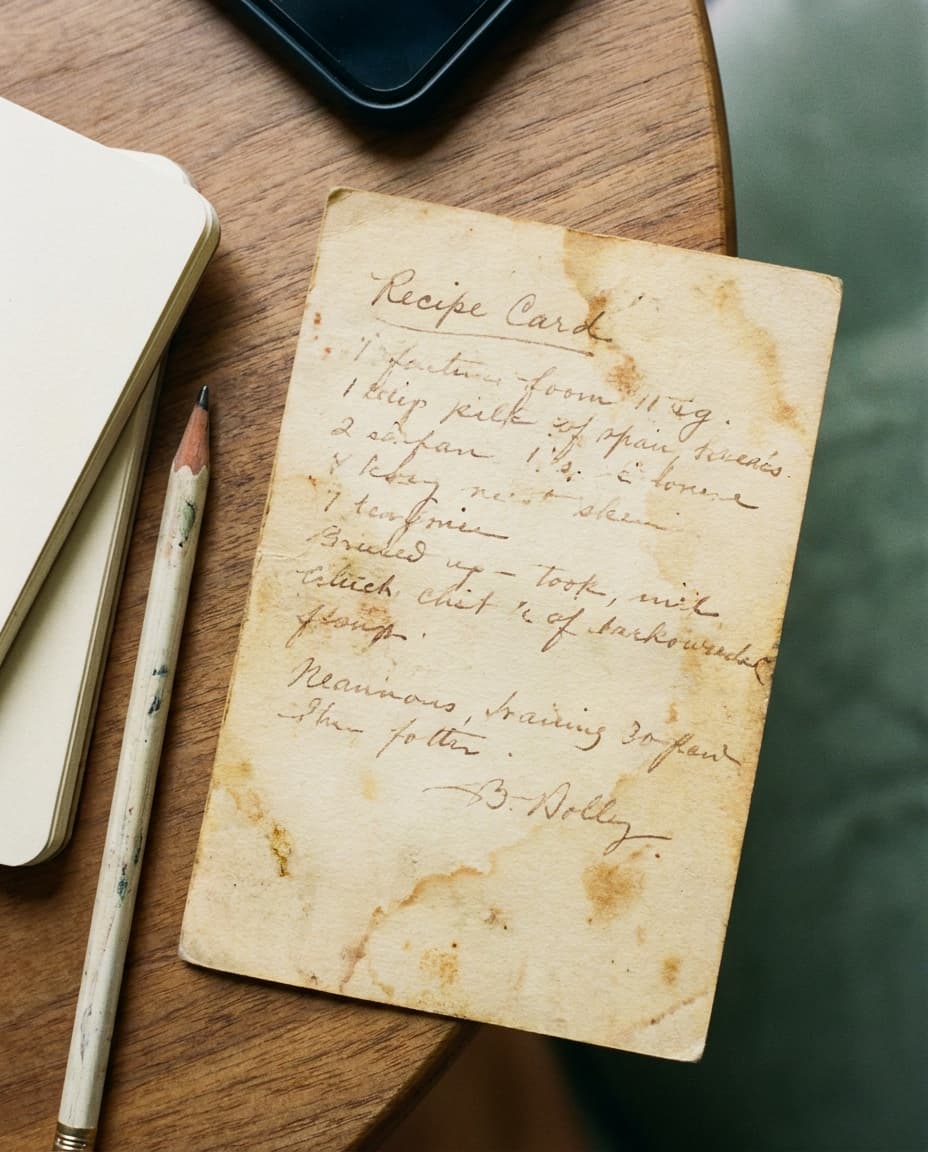
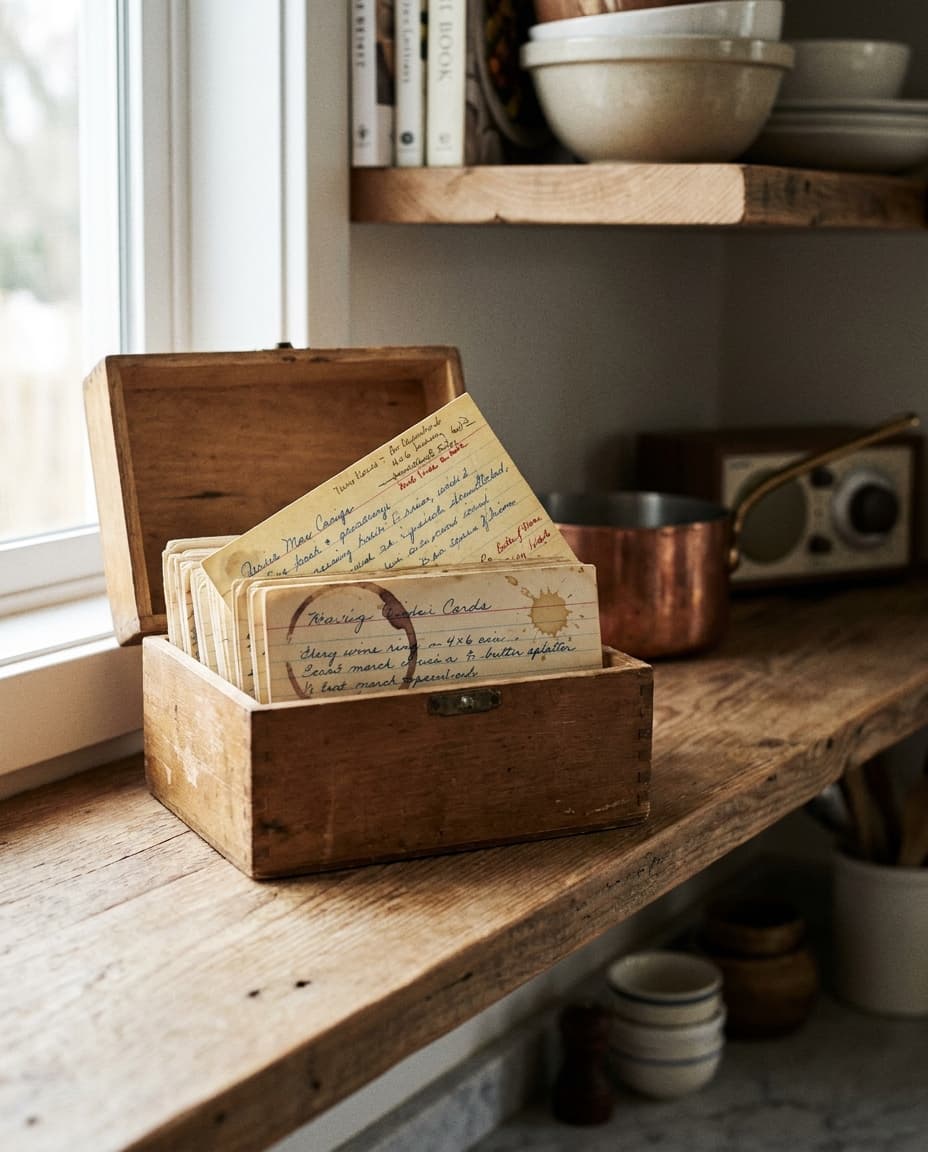
The box is on the shelf above the radio in the kitchen, where it has been since I moved into this flat in 2017. It is a wooden recipe box — walnut, I think, though I have never asked — about the size of two paperbacks stacked. The hinges are brass and have gone dull. Inside are perhaps three hundred index cards, written by my grandmother across forty years, in a hand that became smaller and more careful as she aged, as if she knew, even in the seventies, that someone would one day need to read them.
I do not, in any meaningful sense, cook from the box. I cook from my phone. The recipes I make most weeks are recipes that arrived in an iMessage from my mother, or a screenshot from my sister, or a video from my cousin in Lyon who learned a particular gratin from her mother-in-law and sent it to me one Sunday in November with the caption "essaye, c'est facile." The box is on the shelf because the box is the object. The cooking happens elsewhere. The two facts have, for years now, lived together without much friction, because I have not yet had a daughter who will ask me, one day, where the recipes are.
§ I.How the recipes actually move now.
If you watch, honestly, how a recipe travels between the women in my family in 2026, it goes like this. My mother makes something. She photographs it on her phone, badly, on a yellow tablecloth under the overhead light. She types out the recipe — half from memory, half from a stained card she has had since 1981 — into the iMessage thread that has been running between the four of us since we got her on iOS in 2014. My sister, in Brussels, sees it the next morning and replies with a heart. My cousin, in Lyon, asks for the proportions of the béchamel. I, in Paris, screenshot the message and add it to a photo album on my phone called, regrettably, "Recettes".
Three months later, when I want to make the dish, I cannot find it. The thread has had forty other things in it since November — birthdays, photographs of my niece, a long argument about whether to spend Christmas in Brittany, a link to a coat my mother saw in a window in Saint-Germain. The recipe is somewhere in the scroll. I search for the word "béchamel" and find it, eventually, after about four minutes. I have made the dish; the recipe has, technically, reached me; the system has, technically, worked. But it is not how my grandmother's recipes reached me. Her recipes reached me as objects. These reach me as forensic exercises.
§ II.What the wooden box did, that the iMessage thread does not.
The box did three things, which I have only really understood since it stopped being how the recipes moved. It held the recipes in one place, so you knew where to look. It accumulated marginalia — the splash of brown butter on the card for financiers, the pencil note saying "too much salt, half this" added in 1986 in a hand that was already shakier — so the recipe carried its own history. And it survived its author. My grandmother died in 2009. The box was on her shelf in Auteuil. It moved to my mother's shelf in Vincennes. It is on my shelf now. The recipes inside it have outlived the woman who wrote them by sixteen years, and they will, with luck, outlive me.
The iMessage thread does none of these. It does not hold the recipes in one place; it scatters them across years of unrelated conversation. It does not accumulate marginalia; the only annotations are emoji and the word "miam." And it does not survive its author. When my mother dies — and she will die, because everyone's mother does — the thread will remain on my phone for some time, but Apple's policy on inherited iCloud data is what it is, and the thread is not, in any real sense, a thing that can be passed down. It is a transcript of an ongoing conversation, and conversations end.
The box outlived its author by sixteen years. The iMessage thread will not outlive mine.
§ III.What a 2026 box would actually need to do.
If we are being honest about it, the wooden box's job description was: a shared, persistent, multi-author repository of recipes that could be added to by anyone in the household over a span of decades, accessed without infrastructure, and inherited without legal complication. It is not a small specification. The reason no app fully replaced it for so long is that most apps replaced one or two of those properties and ignored the rest. A note-taking app gives you persistence but no shared editing. A messaging thread gives you shared editing but no persistence. A bookmarks folder gives you neither, really.
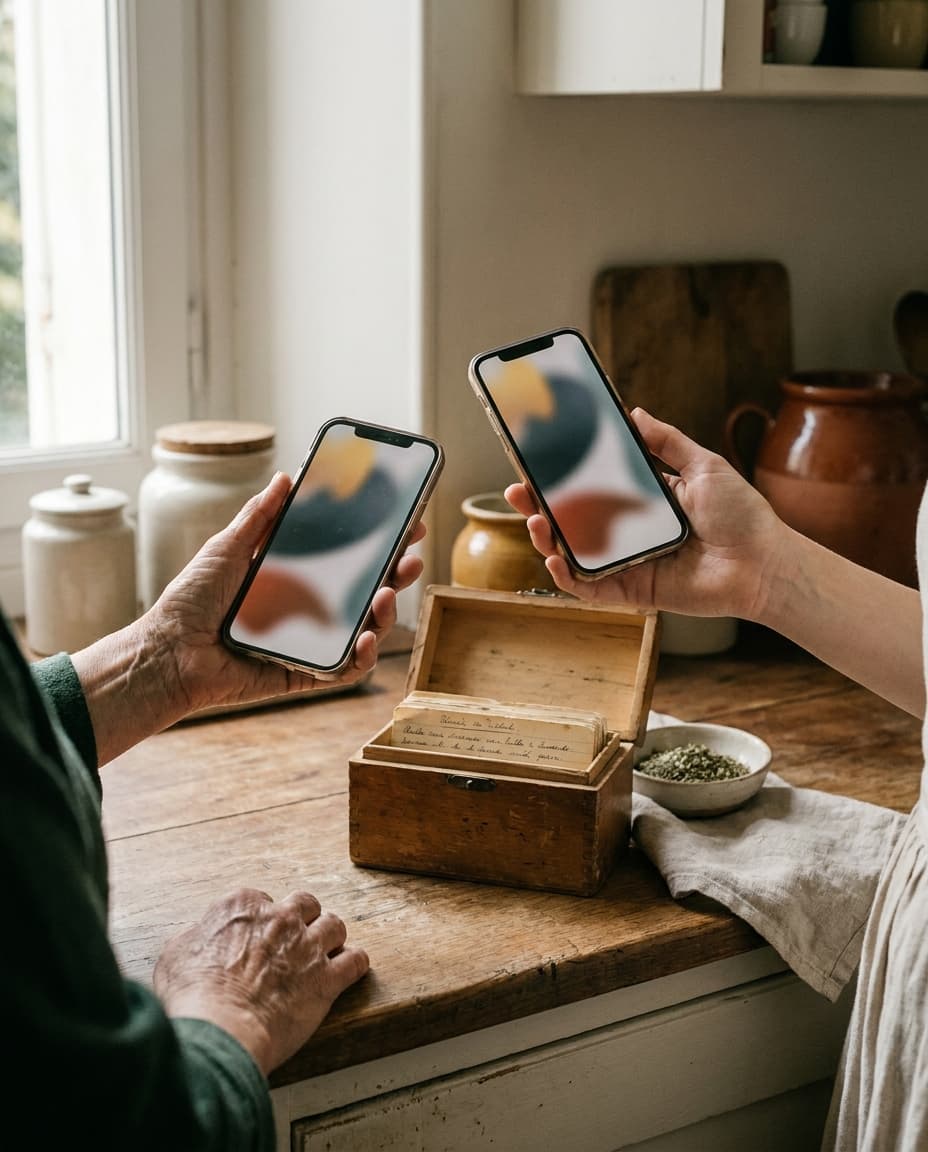
Basil, in the way I have used it for the last several months with my mother and my sister, comes closer to the box than anything I have tried. The mechanism is dull and structural: Family Sharing through the App Store, iCloud sync underneath, and a shared library that all three of us can add to, edit, and reach from any of our phones. My mother adds the gratin she made on Sunday. It appears in my library on Sunday evening. My sister, in Brussels, adds the financier recipe she has been refining for two years, with her own pencil-note equivalent in the notes field — "trop de sel, moitié." It appears in my library too. The thread is no longer the medium. The library is. The conversation about the recipes still happens on iMessage; the recipes themselves live somewhere they can be found.
§ IV.What this does to the work of passing things down.
I do not want to oversell what an app can do here. The wooden box is irreplaceable in the sense that the object itself is the inheritance — the brass hinges, the wood that has gone darker on the lid where my grandmother's hand rested, the smell of paper that has been in a Paris kitchen for forty years. No software replicates that. I am not making the claim that it does. I am making a smaller claim, which is that the function the box performed — the shared, persistent, multi-author library of recipes — can now be performed in a digital form that does not scatter, does not require forensic searching, and does not vanish with the next phone upgrade.
What this means in practice is that the work of passing recipes down has not become easier in 2026, exactly, but it has become possible again in a form it had briefly stopped being. For a stretch of years — let us say roughly 2010 to 2022 — the recipes my mother sent me were, functionally, lost the moment the iMessage scrolled past them. I would make the dish once, when she sent it, and then I would not make it again, because I could not find it. The recipes that came in on the wooden box's cards, by contrast, I have made dozens of times each, because I knew where they were. The shared library is, for the next generation, the box's job in a different material. Less beautiful. More reachable. The trade is, on balance, worth making.
The box is still on the shelf above the radio. It will stay there. I have not moved a single card out of it; I do not intend to. What I have done, this winter, is begin slowly transcribing the cards into the shared library — one a week, on Sunday evenings, with a glass of something open on the counter and the radio on low. My mother, in Vincennes, sees them appear and sometimes adds a note. "Maman mettait plus de muscade." "Le gratin, c'était toujours pour Noël." The marginalia is the recipe, my grandmother used to say, and the marginalia is now distributed across three women in three cities and one wooden box on a shelf in the eleventh arrondissement. The medium has changed. The thread has not. The thread is what gets passed down.