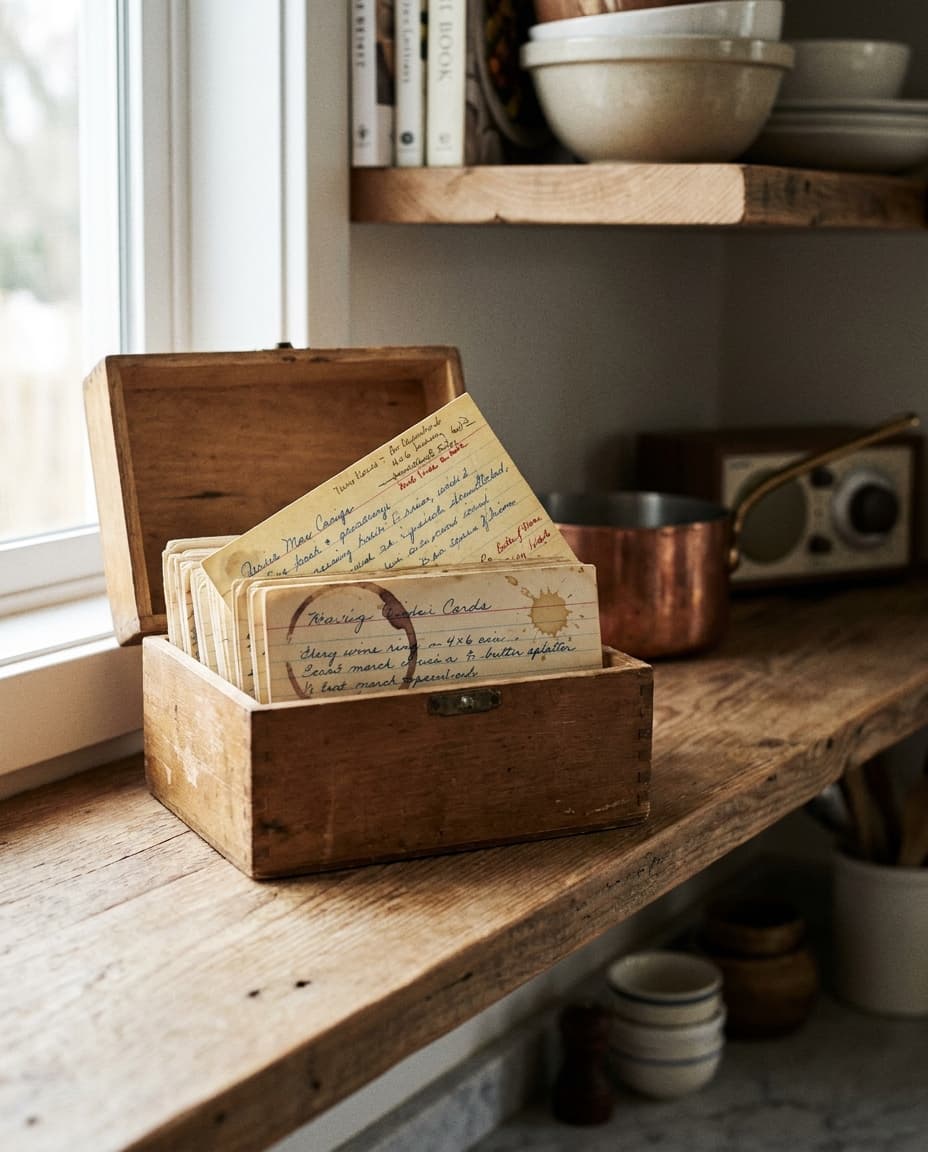
The box is green tin, the lid still closes if you press the corner with your thumb, and inside there are perhaps two hundred index cards held together by the soft tension of decades. Some are typed. Most are written in my grandmother's hand, which slants forward as if always running a little late for something. The cards smell faintly of the cupboard above her stove — flour, paprika, the ghost of an onion she peeled in 1987.
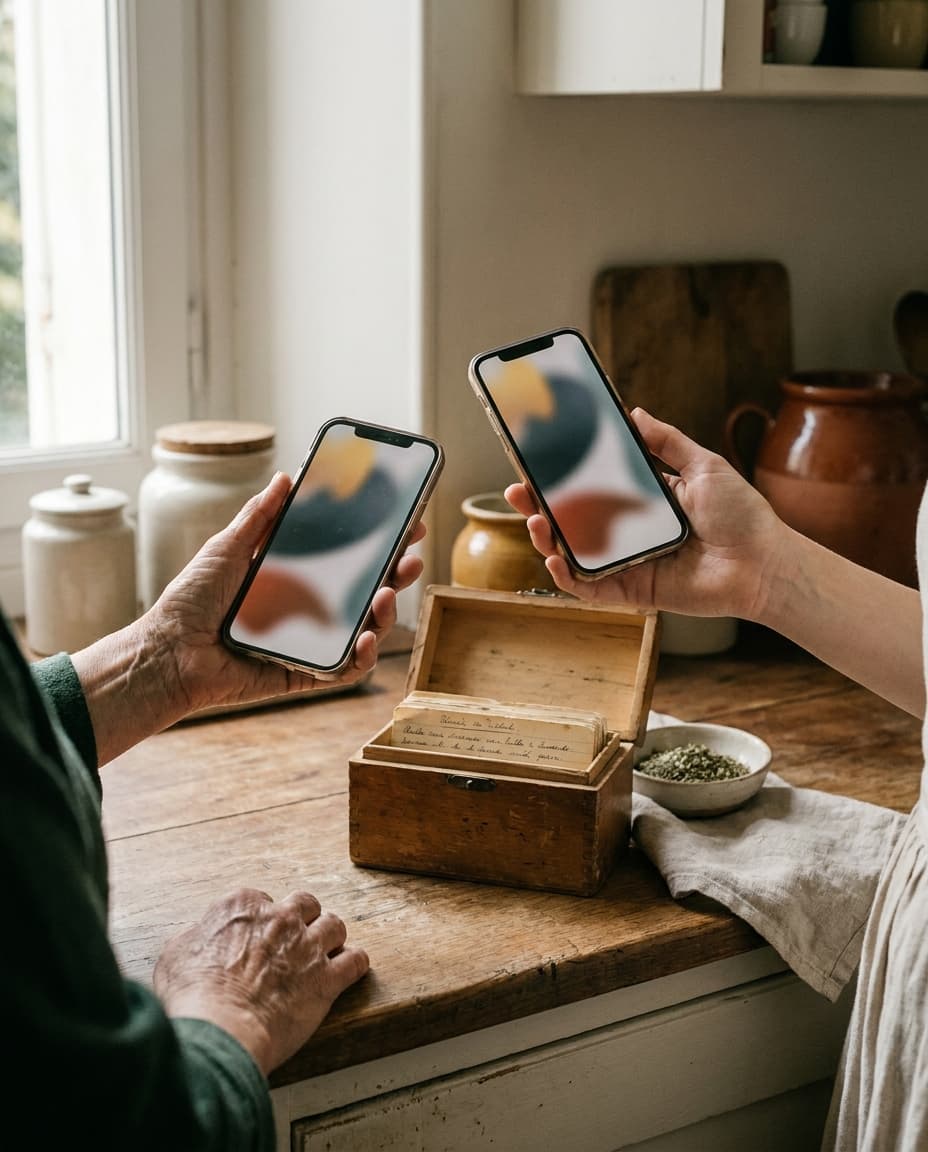
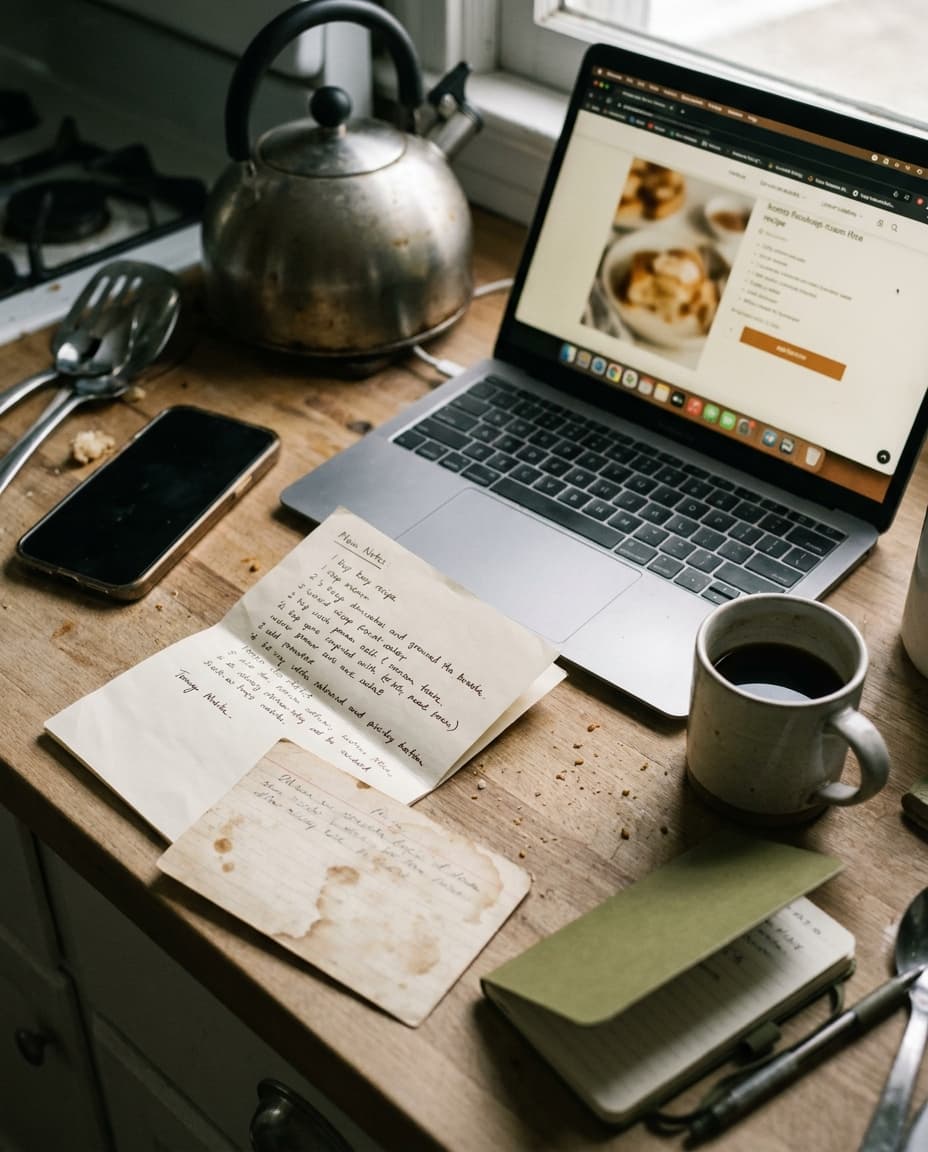
I have had the box for nine years. For eight of those years, I told myself I would digitize it. Last Sunday, finally, I sat down with the box, my phone, and a pot of coffee, and I began. What follows is not a manifesto. It is a small protocol — a handful of decisions I made on the way, and a few I wish I had made earlier.
§ I.Do not start with all of it.
The instinct, when you open the box, is to digitize everything. The whole archive, in order, alphabetical or chronological, no card left behind. This is the instinct that has kept the box closed for nine years. Resist it.
Start with the ten recipes you actually cook. Or the ten you wish you cooked but cannot find when you want them. The point of this exercise, on day one, is to prove to yourself that the work is finite — that a single afternoon yields a small, real thing rather than a project that consumes a winter. The completionism can come later, in increments, on quiet evenings. The first session is for the cassoulet, the apple cake, the dressing for the cucumber salad you have been approximating from memory for a decade.
Pull those ten cards. Put the rest of the box away. The box will wait. It has waited longer.
§ II.Photograph first, transcribe later.
Before you type a single word, photograph the cards. All ten, both sides, one card at a time. This sounds obvious and is, in fact, the part most people skip — and the part they regret most when, three years later, the original ink has faded another shade and the card itself has gone soft at the corners.
A few small specifications. Use daylight if you can; a window at midday is better than any lamp. Lay the card flat on a plain surface — a wooden table, a cutting board, a piece of butcher paper. Hold the phone parallel to the card, not at an angle. Crop tight, but leave the edges of the card visible: you want the artifact, not just the text. And photograph the back, even if the back appears blank. Half the time, the back has a single line in pencil — "add more salt, Mama said" — and that line is the recipe.
Save these photos somewhere you trust for the long term. Not the phone alone. A cloud backup, an external drive, a folder on the laptop that gets backed up by something else. The photos are the source of truth. The transcription is the convenience.
§ III.Transcribe the voice, not the recipe.
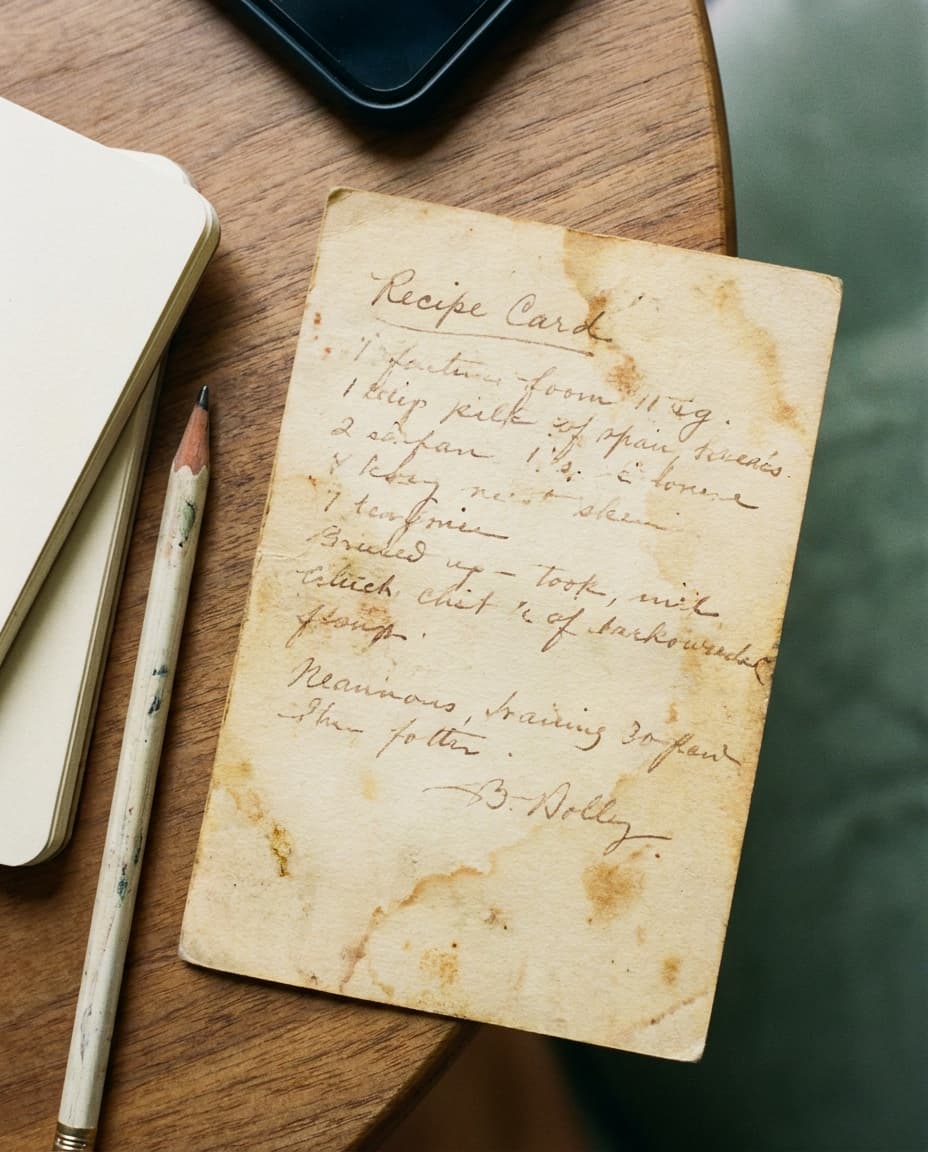
Here is where most digitization projects go quietly wrong. The temptation, when you sit down to type the recipe into whatever app you have chosen, is to clean it up. To translate "a teacup of flour" into 200 grams. To remove "Mama said add more salt" because it isn't an instruction. To turn "bake until it smells right" into "bake 35–40 minutes at 180°C."
Don't. Or rather: do, but in the margin.
The recipe, as your grandmother wrote it, is a document. It is also, in a real sense, the only honest record of how she cooked. "A teacup of flour" was a teacup, in her kitchen, in 1976. The fact that you measured one of her teacups recently and found it held 198 grams is interesting, and worth noting — but it goes in a separate field. The original line stays. "Mama said add more salt" stays. "Bake until it smells right" stays, with a note underneath: "in my oven, 35–40 minutes at 180°C."
The recipe is a document. The standardization is a translation. Keep both. The grandchildren will want the original.
What you are building is not a cleaner recipe. It is a layered one. The voice on top, the conversion underneath, the photograph behind both. Anyone who opens it ten years from now should be able to read what she wrote, and also be able to cook it on a Tuesday in a kitchen she never saw.
§ IV.Tag with intent.
Tagging sounds like a librarian's concern, the kind of thing you skip on the first pass. It is, in fact, the part that determines whether the archive is searchable at all in five years, when you have four hundred recipes in it and you cannot remember which one had the apricot.
Three tag categories carry most of the weight. The first is the source — "Grandmother Astor," "Aunt Cécile," "the woman at the market in Périgueux, 2019." The second is the era, loosely — "pre-1980," "my mother's marriage," "after the move." The third is the occasion, if there was one — "Easter," "the cassoulet for cold weeks," "the cake she made when someone came to visit." These three together turn a pile of recipes into something you can actually navigate by feel rather than by keyword.
I use Basil for the storage layer — ingredients, steps, notes, photos all in one place, and the original card image attached to the recipe so I can always go back to the source. Other tools work. A folder of well-named text files works. The point is not the tool. The point is that the tags are for the person who opens this archive after you, who will not know that "the cake" means the one your grandmother made for your mother's birthday in the year of the long winter.
When I closed the box last Sunday, ten cards lighter, I had not finished anything. I had transcribed perhaps a twentieth of what is in there. But I had built the small machine that the rest of the work will run through — a folder of photographs, a handful of recipes with the voice intact, a system of tags that means something to me. The box on the shelf is no longer a project. It is a routine.
And the cassoulet, when I cooked it Tuesday from the new digital version, tasted exactly the same. Which is to say: it tasted like her hand, reaching for the salt, three or four times before the meal was finished.