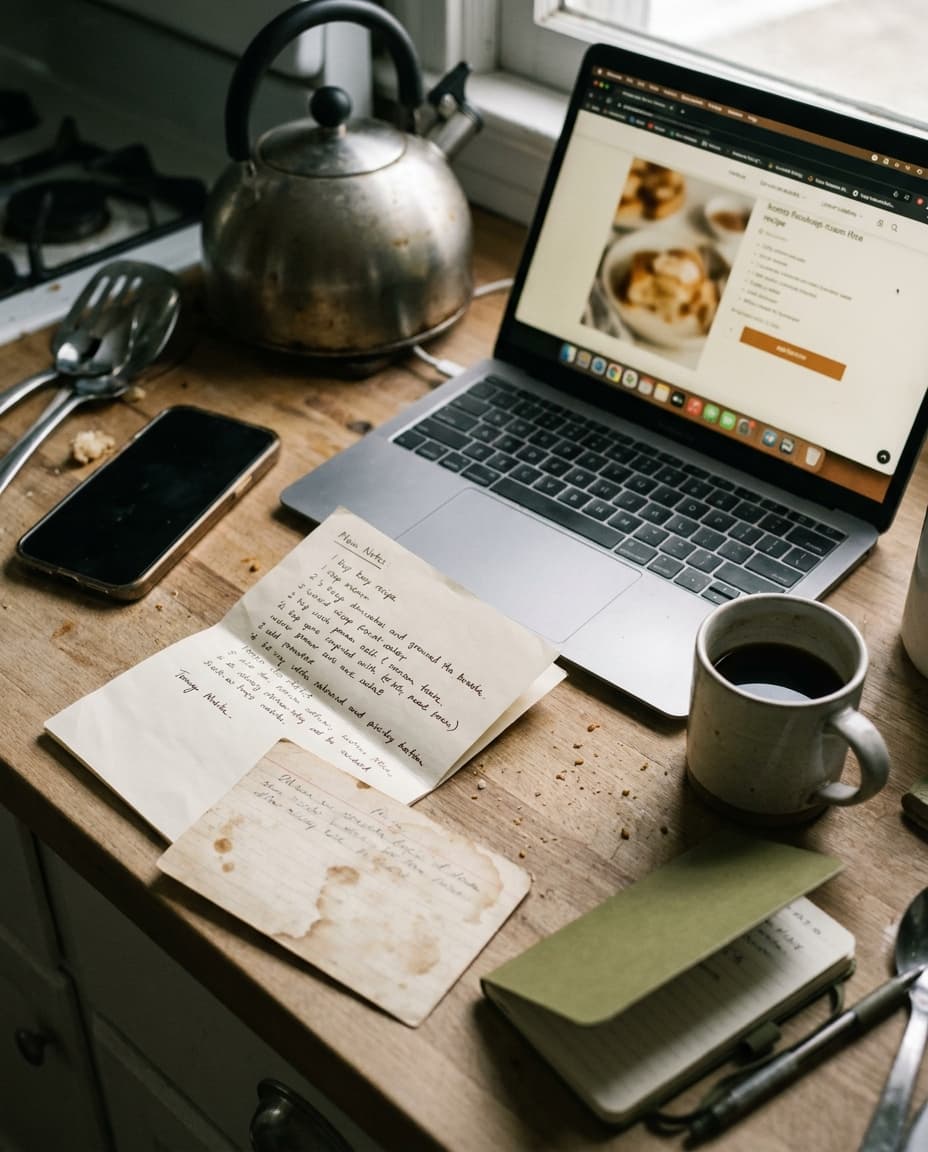
On a Wednesday in March I watched a friend stand in her kitchen with her phone in one hand and a head of cauliflower in the other. She was looking for a recipe she had clipped, three weeks earlier, from an Instagram reel she could no longer find. The recipe was in one of four apps. She did not remember which. The cauliflower waited on the cutting board with the patience of a vegetable that has been through this before.
She found it eventually — in Notes, of course, pasted as a caption with no title — and we ate roasted cauliflower with anchovy and lemon, and the conversation drifted, as it always does among people who cook, to the question of which app, exactly, one is supposed to use. She had four. I have six. Neither of us would defend any of them without qualification. And yet none of us would give them up.
§ I.The shape of the category
The iOS recipe app has been a category for fifteen years and is still, in 2026, oddly unfinished. Each of the major apps does roughly seventy per cent of what a home cook needs. Each is missing a different thirty. The result is the strange ecology of a mature market in which nearly every serious cook ends up using at least two products in tandem — one for clipping, one for cooking, one for the shopping list, one for the recipes their mother actually emailed them in 2014.
There are, broadly, four philosophies. The power-user organizer, exemplified by Paprika. The community-and-discovery platform, exemplified by what used to be Whisk. The reading-first reader, exemplified by Mela. And the no-app app — Apple Notes, the reigning champion of the category by sheer volume of human use, despite never having intended to be in it. Basil, the newest serious entrant, sits across the middle of these, attempting a fifth thing: the general-purpose answer for a cook who would prefer to keep one library.
What follows is a reviewer's notebook. I have used all six apps for at least a year. I do not believe any one of them is the right answer for everyone, and I am suspicious of anyone who tells you otherwise. I will tell you what each is for.
§ II.Paprika
Paprika 3 has been on the App Store, in some form, since the early 2010s. It is the elder statesman of the category and it shows — in both the ways one might mean that. The web-clipping browser is still, after all this decade, the most reliable in the business. You point it at almost any recipe site and it pulls the ingredients and the steps out cleanly, with no babysitting. The meal planner is sturdy. The grocery list works. There is a one-time price (per platform) and a small annual subscription for sync.
What Paprika does not do is move quickly. The interface is the interface it had in 2014, and one can feel the decisions of that era in every screen — dense, utilitarian, slightly stern. Imports from Instagram, TikTok, or YouTube are not its strength; the modern recipe, which arrives more often as a video caption than a structured page, is not really what its parser was built for. Photo handling is workmanlike at best.
If you bought Paprika in 2015 and you have eight hundred recipes in it, the right answer is probably to stay. The library is the whole point of a library. If you are choosing today, the math is different.
§ III.Whisk, now Samsung Food
Whisk arrived as a beautiful idea: a free, web-first recipe organizer with a smart shopping list and a sociable feel. Then Samsung bought it, renamed it, and steered it — gently, then less gently — toward something larger. Today Samsung Food is a discovery platform with a recipe organizer attached, rather than the other way around. The community library is genuinely large. The grocery integration with delivery services is the best in the category. There is, increasingly, AI.
I have heard from long-time Whisk users — people who used it daily, before — who feel the app stopped being theirs somewhere along the way. That is not a complaint about quality. The new app is, by most measures, more capable. It is a complaint about identity. The product they loved was a personal organizer. The product they have is a feed. Both are legitimate things. They are not the same thing.
Each app excels at seventy per cent of what a home cook needs and is missing a different thirty.
§ IV.Mela
Mela is, on a per-pixel basis, one of the most beautifully designed apps on iOS. It is the work of Silvio Rizzi, who also makes Reeder, and the inheritance shows: Mela treats recipes the way Reeder treats articles. There is an RSS-style discovery layer that pulls new posts from your favourite recipe sites the way a feed reader once pulled blog updates. The reading view is gorgeous. Typography that respects the recipe as a piece of writing.
What Mela does not try to be is comprehensive. The meal planning is light. Grocery aggregation is present but not the focus. The product is, deliberately, a reader. If most of your relationship with recipes is the act of reading them — saving the ones that move you, returning to them on a Sunday morning with coffee — Mela is unrivalled. If most of your relationship with recipes is cooking dinner on a Tuesday, you will eventually want something else open at the same time.
§ V.Crouton
Crouton sits in roughly the same neighbourhood as Mela — Apple-native, beautifully made, subscription-priced, with an unusually strong tvOS app for the cook who wants the recipe on the kitchen television. It is small in scope and decisive about what it is. The cooking timers are excellent. The design is calm. Power users sometimes find its constraints constraining; lovers of constraints find them clarifying.
I mention Crouton because it deserves to be in this conversation more often than it is, and because it represents a real position: that the recipe app should be small, polished, and deeply personal — closer to a Moleskine than to a database.
§ VI.Apple Notes
Apple Notes is the most-used recipe app on iOS. It was not designed for the job. It does the job anyway, for tens of millions of cooks who have never installed any of the apps above and never will. The friction is zero. It syncs everywhere. The folder titled "recipes" is open already.
The breaking point, for most of the people who eventually leave Notes, comes somewhere around the thirtieth recipe. Below that, search is fine, structure is unnecessary, and the whole thing fits in your head. Above it, the cracks appear: no scaling, no ingredient list that becomes a shopping list, no cooking mode that keeps the screen awake, no way to filter by what is in the fridge, no way to flag the peanuts when your sister-in-law visits. Notes is the right answer for the cook who keeps three things. It is a worse answer at thirty, and a punishing one at three hundred.
§ VII.Basil
Basil is the youngest of the six and the one whose ambition is clearest: to be the general-purpose answer. It tries, more than any of the others, to do all of it — and to do it without a subscription, without ads, without nag.
What it gets right, at least in my use of it, is the boring middle of the workflow. One-tap import works on websites, on Instagram reels, on YouTube videos, on the screenshot of a recipe my mother sent me last Tuesday. The cooking mode keeps the screen on, advances steps with a swipe, and is the rare app that I can use with cabbage on my hands. The meal planner is a calendar you can actually drag things onto. The grocery list aggregates across the week and groups by aisle without being asked. Allergens — and this is the small thing I find I value most — get tagged at the household level and flagged on every recipe automatically.
What Basil does not do is beat Mela on the beauty of the reading view, or Paprika on the depth of fifteen years of organizational features, or Samsung Food on the size of a community library. It is not trying to. It is trying to be the one app you have open when dinner is happening, and on that narrow but consequential test, in 2026, I think it is the most complete answer in the category.
§ VIII.Who each is for
Paprika is for the organizer who has been at this for a decade and trusts what they trust. Whisk — Samsung Food — is for the cook who likes a feed, and likes finding new recipes by scrolling. Mela is for the reader, the Sunday-morning person, the one whose phone is also a magazine. Crouton is for the minimalist who would like one beautiful object on the counter. Apple Notes is for the cook who keeps three recipes and means it.
Basil is for the rest of us — the cook who imports from everywhere, plans across the week, shops on Saturday, cooks on Tuesday, and would like the same library to hold all of it without asking for a credit card. The cauliflower recipe should not require a search across four apps. The hand goes for the phone the way it goes for the salt. It should know where it is going.
The question, in the end, is not which app is best. The question is which app is yours. Six apps, on one phone, on a Wednesday in March. None of them, alone, the complete kitchen. One of them, more often than not, the place dinner happens. That is the only test that matters.