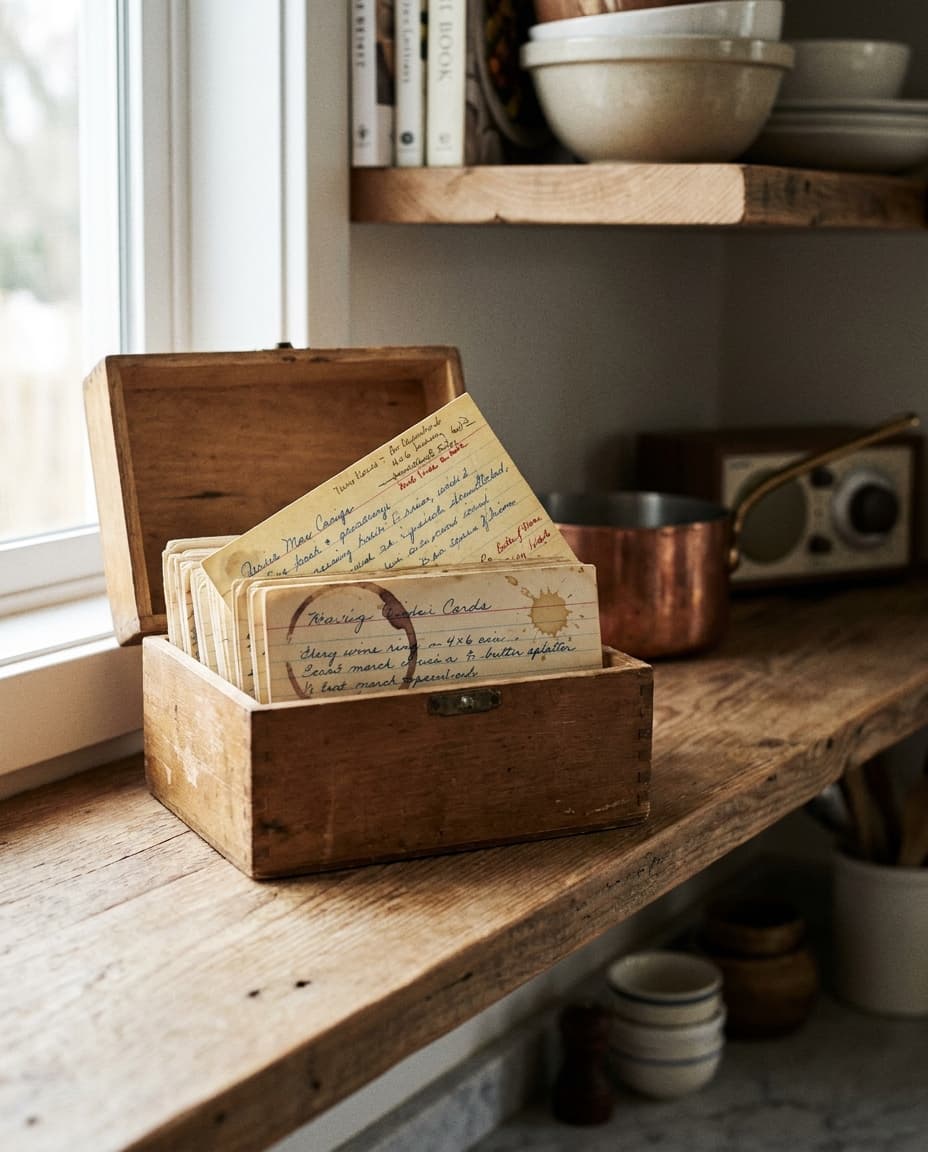
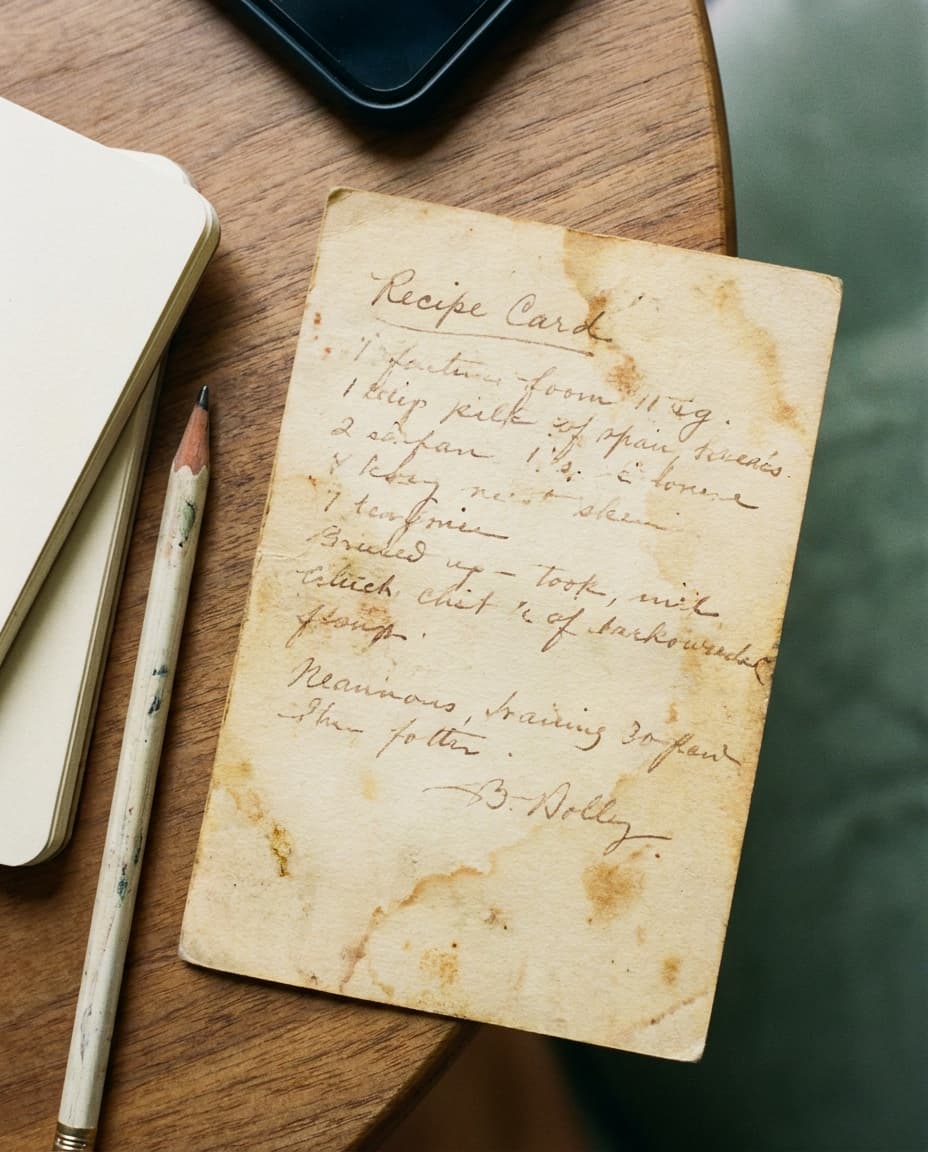
It is the eighth time I have made the bean stew, and standing at the stove on a Tuesday in February — the windows fogged, the radio low, the cat asleep on the chair where she is not supposed to be — I realise, at last, that the salt is going in too late. The original recipe says to season at the end. I have always seasoned at the end. The beans have always been a little flat in the centre and a little aggressive on the surface, and I have always blamed the beans.
Tonight, on the eighth attempt, I salt the soffritto. I salt the beans when they go in. I salt the broth before it reduces. The stew, when it is done, tastes like itself for the first time. I want to write this down. I want to write it down where the recipe lives, so that on the ninth attempt, and the eleventh, and the twentieth, the salt goes in early without my having to remember why.
§ I.The Recipe Is the Iterations.
Cooking is not a single act. It is a sequence of attempts, separated by weeks, sometimes years, in which the cook learns one small thing at a time. The first time you make a stew, you follow the recipe. The third time, you notice the timing is off. The seventh, you realise the herb is wrong. The tenth, you find the order of operations that the recipe's author never bothered to write down because, to her, it was obvious.
What you are doing, across those ten attempts, is editing the recipe. The dish you eventually serve to friends — the one they ask for, the one you are quietly proud of — is not the recipe in the book. It is the recipe in the book plus eight quiet corrections, none of which exist anywhere except in your head, and which you will lose entirely if you go six months without making it.
This is the part that most recipe apps refuse to acknowledge. They treat the recipe as a published artifact. The author wrote it; the user reads it. The transaction is complete. But anyone who has cooked the same dish more than three times knows the transaction is not complete. The recipe is alive. It is being rewritten, slowly, in the cook's hands.
§ II.The Notebook in the Other Room.
There are workarounds, of course. None of them work. You can copy and paste the recipe into a new note, edit your version, and lose track of which is the original. You can leave a comment at the bottom — but no one reads comments at the stove, and many apps do not allow them at all. You can keep a separate notebook, the one with your real notes, except that the notebook is in the other room, and the recipe is on the screen, and at the moment you need to write the salt note down you are holding a wooden spoon and a hot pan and you do not have a hand free to walk anywhere.
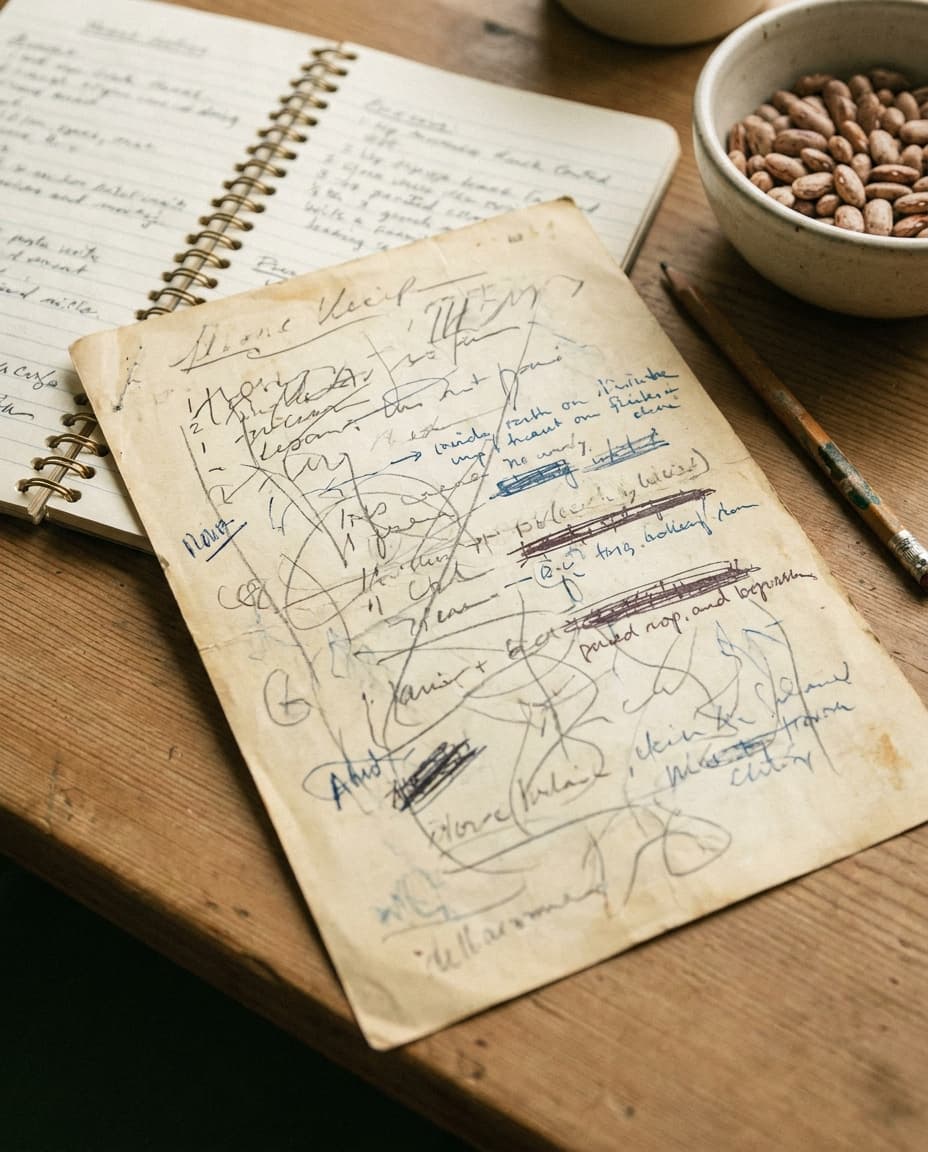
My grandmother's solution was simpler. She wrote in the margins. Her copy of the Pantagruel cookbook — the Portuguese one, from the sixties — has my grandfather's handwriting along the side of the bacalhau recipe noting, in pencil, that the cod must be soaked for thirty-six hours, not twenty-four. There is a darker note, in pen, presumably added later, that says "forty-eight". The recipe in the book and the recipe she actually cooked were not the same recipe, and the difference was inscribed, visibly, in the place where the cooking happened.
The recipe in the book and the recipe she actually cooked were not the same recipe, and the difference was inscribed, visibly, in the place where the cooking happened.
Most digital recipe tools have lost this. They give you the document and call it the recipe. The cook's accumulated wisdom — the stuff that is, arguably, the entire point — has nowhere to live.
§ III.What an Honest Recipe App Looks Like.
An honest recipe app would let the cook edit the recipe in place. Not a fork, not a duplicate, not a comment thread — the recipe itself, mutable, owned by the cook, treated as a working document. It would also keep a history, because version five is sometimes the right one and version eight, in retrospect, was a wrong turn the salt did not need. It would surface the cook's own notes prominently, above the original author's prose if necessary, because it is the cook who is standing at the stove tonight.
Basil works this way. Each recipe in the library is yours to edit — directly, in place, without ceremony. Change the salt instruction; reorder the steps; cross out the herb you have never had in the house and write in the one you do. Every edit is kept in a small history attached to the recipe, so that if version-five turned out to have been better than version-six, you can scroll back and see what you changed. The notes field sits at the top of the recipe, not buried underneath, because that is where you will look at seven in the evening with a spoon in one hand. Add a photo of how it looked the night it was perfect, and the photo lives on the card too — eight attempts, eight photos, the dish slowly becoming itself.
§ IV.The Salt, Going In Earlier.
There is a humility in keeping the history. It admits that the cook of two years ago knew something the cook of today does not, and that the next version may well be wrong. It admits that taste drifts, that the kitchen changes, that the bean from last summer was not the bean from this winter. The recipe accrues, the way a notebook accrues, the way a kitchen accrues — slowly, with corrections in different inks.
This is also, incidentally, how a recipe gets passed down. Not as a pristine document handed from one generation to the next, but as a layered thing — the original printed text, the grandmother's pencil, the grandfather's pen, the granddaughter's note that the pen note was, in fact, also wrong. A recipe with a history is a recipe a person can inherit. A recipe without one is just a file.
The stew is on the table. The salt went in earlier this time, and the beans taste the way I have wanted them to taste for three years. Before I sit down I open the card on my phone and add a single line under the soffritto step: salt here, generously. The edit is saved; the previous version is still there, in case I am wrong about all of this. The cat, who is always wrong about where she is allowed to sleep, has not moved.