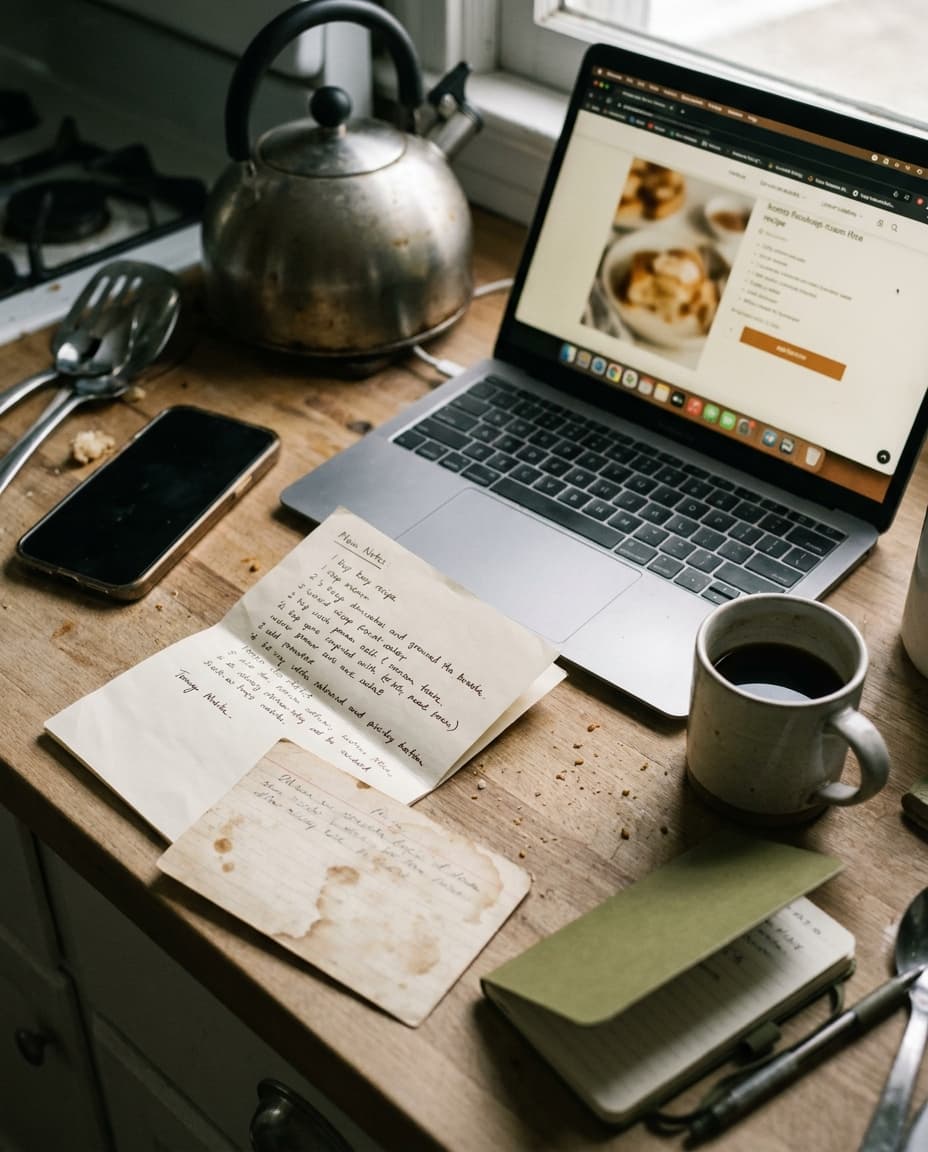
There is a folder in my mother's iPhone, inside the Notes app, titled simply "recipes." It contains forty-three notes. Some are pasted from emails, in three different fonts. Some are screenshots of websites she does not remember the names of. Two are voice memos transcribed by Siri and never re-edited. There is a note titled "Aunt Margaret pie" that contains, in its entirety, the word "buttermilk." My mother has cooked from this folder for eleven years. She has no plans to switch.
She is, statistically, the median iOS recipe app user. The most-used recipe app on the platform was not designed to be a recipe app. It is also, in many ways, the right answer — until, very specifically, the moment it isn't.
§ I.What Apple Notes gets right
Apple Notes is the rare piece of software that benefits from having no opinion about itself. It does not believe it is a recipe app. It believes it is a note. The note can hold a paragraph from your sister, a screenshot of a Bon Appétit page, the URL your friend texted you, the picture of a handwritten card from your grandmother that you photographed at Thanksgiving. It will sync to every Apple device you own, including the iPad on the kitchen counter, including the Mac on which you do your taxes. It is free. It is already installed. It works.
Friction is the main thing it does not have. There is no import workflow. You paste, or you screenshot, or you forward an email to yourself. The note exists. The recipe is in it. You can search across the entire folder for the word "buttermilk," and Aunt Margaret's pie will come back, eleven years later, with the right answer.
If you cook from three recipes, if you cook from five, if you cook from a dozen — Notes is the right answer. The friction of installing a real recipe app is, at that volume, larger than the friction it removes. I will defend this with some force.
§ II.Where Basil differs
The breaking point, for most cooks who eventually leave Notes, comes around the thirtieth recipe. There is no single bell that rings; there is a slow accumulation of small wrongnesses, until one Tuesday you stand in the kitchen and realize the app you are using is fighting you.
Notes does not separate ingredients from steps. This is not a problem at five recipes; at fifty, it means you are scrolling, every time, past the same wall of text to find the line you want. Notes does not scale a recipe. The four-person braise that has to feed eight on Sunday is your problem to multiply, in your head, with wet hands. Notes does not aggregate a shopping list across recipes. If you are cooking three things this week and they all want onions, you have three onion entries in three different notes, and the question of how many onions you actually need is a small math problem you are now doing in the produce aisle.
Notes does not have a cooking mode. The screen sleeps. The screen sleeps when your hands are covered in flour. You wake it with the side of your wrist, leaving a print, and the cursor is in the wrong place, and the next step is at the bottom of the note, and the timer you wanted is in a different app entirely.
Notes does not know about your household's allergies. It will not warn you that the recipe a friend sent you contains peanuts on the day your sister-in-law is visiting. It cannot, because it is a notes app.
Basil does these things — and a few more, less critically but pleasantly. One-tap import from any URL or social post puts the recipe in cleanly, parsed. Cooking mode keeps the screen on and advances steps with a swipe. The grocery list aggregates across a meal plan and deduplicates onions. Allergens get tagged once, at the household level, and flagged on every recipe automatically. iCloud sync is included; there is no subscription.
Notes is the right answer for the cook who keeps three recipes. It is a punishing answer at three hundred.
§ III.The deeper philosophy
There is a useful distinction between an app that does not stop you from doing something and an app that helps you do it. Notes is the first kind, for recipes. It does not stop you from cooking from a folder of pasted text and screenshots. It helps you almost not at all, but it does not stop you, and that is the entire reason it has won the category by sheer use.
The case for a real recipe app is not that Notes is broken. Notes is not broken. The case is that there is a particular shape to the work of feeding a household — recipes that arrive from many places, ingredients that have to consolidate into a list, dinners that have to land on specific evenings, hands that are wet at the moment the next step is needed, allergies that have to be remembered every single time — and that an app shaped for this work removes a tax that a general-purpose app, by design, leaves in place.
The tax is small per occurrence. The tax compounds. After three hundred recipes the cook has paid it about ten thousand times, and feels, vaguely, that cooking from their own library is harder than it ought to be. The library is not the problem. The container is.
§ IV.Who each is for
Apple Notes is for the cook who keeps three things. Or five. Or a dozen. The cook for whom the recipe folder is essentially a memory aid — the way the lemon pasta goes, the way the family stuffing goes, the URL of the chocolate cake. The cook whose mother emails them recipes and who would like to keep them somewhere obvious. Notes is, for this cook, the right answer, and I would not move them off it.
Basil is for the cook whose three recipes have become thirty, and then three hundred. Whose dinners are planned, not improvised. Whose grocery list comes out of the meal plan, not out of the head. Who wants one library, on the kitchen counter, organized for their household, with the cooking mode the screen does not sleep on, and the allergy flag the app does not forget.
My mother, for the record, will probably never leave the folder titled "recipes." She has cooked from it for eleven years. It contains, among other things, Aunt Margaret pie, which is to say it contains the word "buttermilk," which is to say it contains everything she needs. Notes is the right answer for the cook who keeps three things. Basil is the answer when those three become thirty, and then three hundred, and the hand goes for the phone the way it goes for the salt.