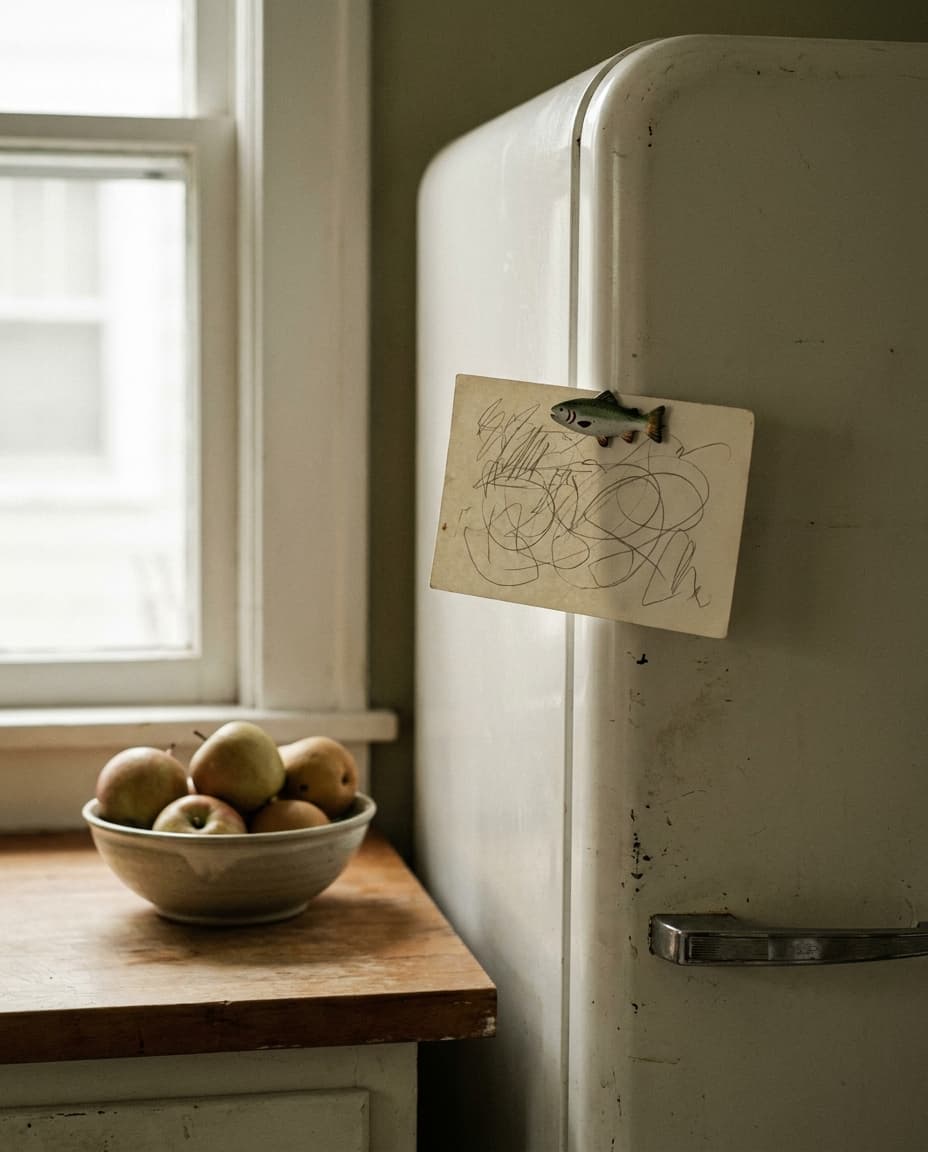
Pinned to the side of my refrigerator with a magnet shaped like a sardine, there is a card. On it, in pencil, are written four dinners — Monday roast chicken, Tuesday pasta with the chicken, Thursday fish, Saturday lentils. Wednesday, Friday, and Sunday are blank. The blanks are not laziness. The blanks are the point.
I have spent perhaps a decade trying to plan dinner for an entire week and failing every time, in roughly the same way. By Wednesday, the plan has been overtaken by reality — a late meeting, a forgotten ingredient, a sudden craving for a thing that wasn't on the list. I used to consider this a failure of discipline. I have come, more recently, to consider it a failure of planning.
§ I.Four, not seven.
The first rule, and the hardest one to accept, is that a household of two does not need seven dinner plans per week. It needs four. The other three nights are taken up by leftovers, by takeout, by the meal that gets assembled from what is already in the fridge, by the dinner that doesn't happen because someone ate a late lunch.
If you plan seven, you will execute four. The other three plans will rot quietly in the back of the crisper drawer as the celery you bought for Thursday goes limp on Saturday. If you plan four, you will execute four — and the three remaining nights, freed from obligation, will reveal themselves as a kind of structural slack the household actually requires. Wednesday becomes the night the chicken stretches into a second meal. Friday becomes the night you eat at the place around the corner. Sunday becomes the night someone stands in front of the open fridge and improvises.
Four is honest. Seven is theater.
§ II.Plan around the protein, not the recipe.
Most meal-planning advice begins at the wrong end. It assumes you start by browsing recipes, picking the ones that look exciting, and then assembling a shopping list from the union of their ingredients. This is how you end up buying half a fennel bulb you will use once and an exotic chili paste that will outlive your tenancy.
The professional approach is the opposite. You start at the market, or at the meat counter, or at whatever your equivalent is, and you ask: what looks good this week, and what is on offer? You buy the protein first — a whole chicken, a piece of fish that was caught nearby, a kilogram of lentils because it is winter — and the meals follow from there. The chicken becomes Monday's roast and Tuesday's pasta. The fish becomes Thursday. The lentils, on a Saturday, with a bay leaf and an onion and a glass of wine.
This is a small inversion, and it changes everything. The plan stops being a list of dishes and starts being a sequence of decisions about ingredients. The grocery list shrinks. The waste shrinks with it.
Plan the protein first; the dinners follow. Plan the dinners first; the celery dies on Saturday.
§ III.The list is the plan's twin.
Here is the thing nobody who writes about meal planning seems to say plainly: the meal plan and the grocery list must be made at the same time, in the same sitting, by the same person, looking at both. They are not two documents. They are two views of one document.
If you make the meal plan on Sunday morning and the grocery list on Sunday afternoon, you have already lost. By the time you sit down with the list, you have forgotten which onion belonged to which dish, whether you already had the rice, what you actually decided about Thursday. You will overbuy three things and forget the lemon, which is the only thing that matters.
I now do both at once, on the small card on the fridge. Four dinners, the protein for each, and below them a short list of what I do not already have. Onions I always have. Garlic, the same. Olive oil, salt, vinegar, dried pasta, rice, lentils, anchovies, capers — the pantry is not on the list because the pantry is the foundation. The list is the small, specific delta between what I have and what this week's four dinners will need. It is rarely longer than fifteen items.
I use Basil's weekly calendar for the planning side — drag a recipe onto Monday, drag another onto Tuesday, and the app composes the grocery list from the ingredients automatically, deduplicating where two recipes share an onion. This sounds like a small thing and is, in fact, the difference between a workflow that lasts a month and one that lasts a year. The mechanical work disappears. The decisions remain.
§ IV.One ambitious meal. No more.
Of the four planned dinners, exactly one should be ambitious. The roast chicken, the long-braised lamb shoulder, the risotto that requires standing at the stove for forty minutes. The other three should be efficient — assembled in thirty minutes, eaten in twenty, washed up in ten.
The temptation, in the early enthusiasm of meal planning, is to plan four ambitious meals. This is the same impulse that produces gym schedules with workouts every day at six in the morning, and lasts approximately eleven days. One ambitious meal a week is enough. It satisfies the part of you that wants to cook seriously without bankrupting the part of you that has to be at a meeting on Tuesday at six.
Pick the night you'll have the most energy. For me, that is usually Saturday or Sunday, depending on the week. The ambitious meal goes there. The other three meals get scattered across the weeknights with no particular ceremony — pasta, a fish, a bowl of something with lentils. Quick, repeatable, mostly forgettable. Which is fine. Most dinners should be.
Last week's card had roast chicken on Monday, pasta with the leftover chicken on Tuesday, hake on Thursday, lentils with chorizo on Saturday. Wednesday I ate the rest of the pasta cold, standing up, while reading something. Friday we ate at the place around the corner. Sunday I stood in front of the open fridge for a long minute, found half a head of cauliflower and an egg, and made dinner from them. None of the unplanned nights was a failure. They were what the plan had made room for. The card on the fridge had done its work by Tuesday, and after that it was only there to remind me what was already in the freezer.