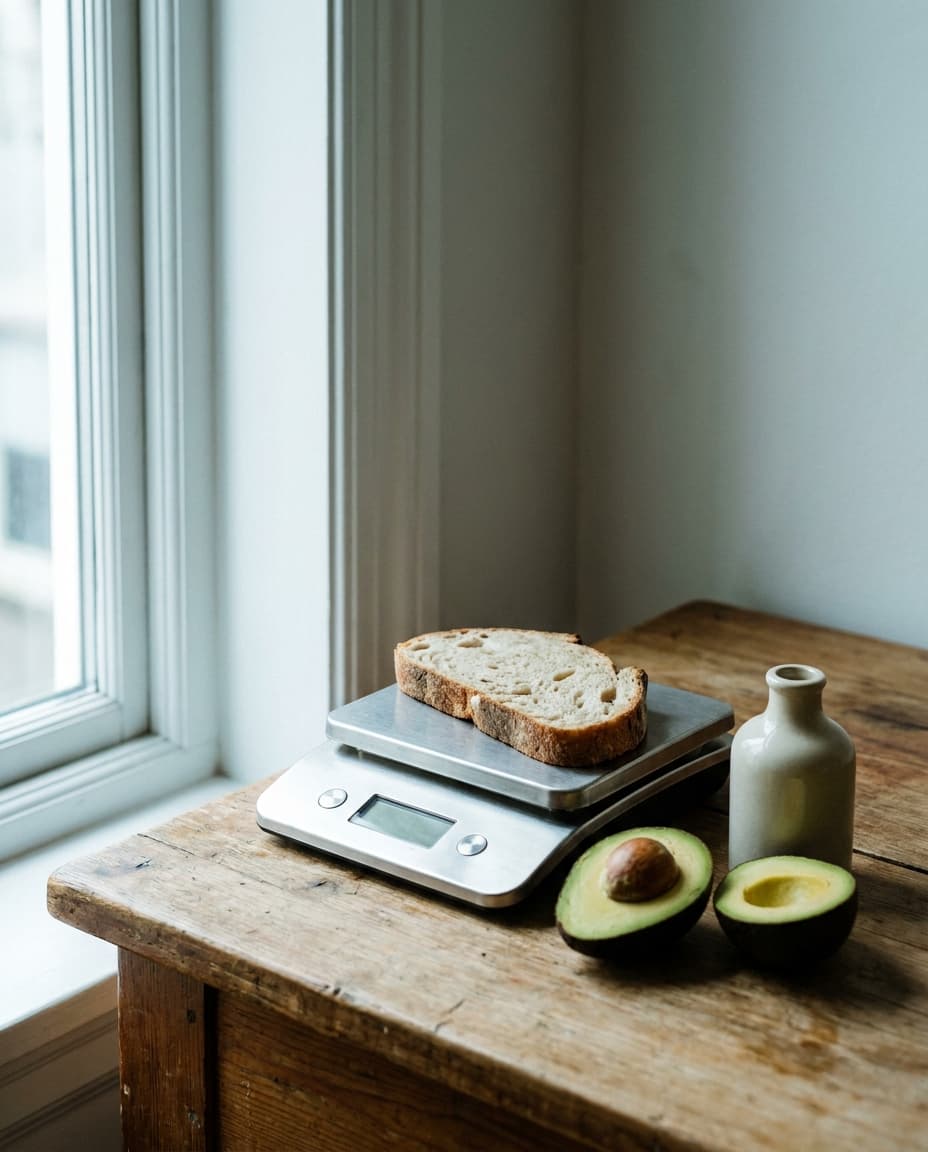
On a small kitchen scale on a Tuesday in February, two slices of sourdough register at 134 grams. The avocado, halved and pitted, comes in at 96. The olive oil, drizzled in a gesture I have always considered restrained, lands at 17 grams — which, multiplied by nine, is 153 calories of olive oil on a breakfast I had been quietly telling myself was light.
I am not, in any meaningful sense, on a diet. I am simply, this month, looking. The looking is the point.
§ I.The two camps, equally tedious.
The conversation about calorie tracking has, for a decade now, been organised into two camps that mostly hate each other. On one side, the optimisers — who weigh their oats, log their espresso, and treat the daily macro split as a moral exercise. On the other, the intuitives — who consider any tracking at all to be a relic of diet culture and a step toward an eating disorder. Both camps are partially right. Both are exhausting.
The optimisers are right that most people have no idea what they eat. The intuitives are right that turning every meal into a spreadsheet is, in the long run, a worse problem than the one it solves. The interesting position — the only one that survives an honest look at the evidence — is in between, and it has the disadvantage of being unsexy. It cannot be sold as a programme. It will never have a hashtag.
§ II.Tracking as a diagnostic, not a religion.
There is a thing that happens when you track your food carefully for thirty days. You find out where the calories actually live. They are almost never where you thought. They are in the olive oil. They are in the cream that goes into the pasta you make on Wednesdays. They are in the four glasses of wine across the week that you had stopped counting because they were habitual. They are not, generally, in the dessert you have been feeling guilty about.
This is useful information. It is the kind of information that, once seen, stays seen. You do not need to track for a year to learn it. You need to track for a month — perhaps two — and then you can put the scale away with a much better map of what you are eating than you started with. The problem is not tracking. The problem is tracking forever.
Track for a month. Learn where the calories live. Then put the scale away.
§ III.The pathology of permanent measurement.
I have a friend who has logged every meal she has eaten for eleven years. She is not overweight. She has never been overweight. She is, by any conventional metric, the success case for tracking. She is also, by her own admission, unable to eat a meal at a restaurant without first looking up the menu and pre-budgeting. She cannot accept a sandwich at a friend's house without estimating it. The act of eating, for her, has been permanently colonised by the act of measuring.
I do not think this is an indictment of tracking as a tool. I think it is an indictment of tracking as a permanent state. A scale is useful in the kitchen. A scale is less useful as a piece of furniture you can never leave the house without. The transition — from diagnostic to identity — is the part the apps do not warn you about, because the apps are paid by retention. They benefit from your continued logging. You, after about month three, do not.
§ IV.What the number is, and is not.
A calorie figure on a recipe is not the truth. It is a useful approximation. The avocado is a range. The olive oil is, depending on whose pour you are using, off by twenty percent. The bread, depending on hydration and bake, varies. Anyone telling you they are eating exactly 2,140 calories today is performing precision they do not possess.
What a calorie figure is, honestly, is a magnitude. It tells you whether the dish in front of you is a 300-calorie dish or a 900-calorie dish. That is a useful distinction. It does not tell you whether it is 612 or 638, and the moment you start caring about that distinction is the moment the tool has begun working you instead of the other way around.
§ V.What recipe apps should and should not do.
Most recipe software now ships with calorie estimates of some kind. The good ones treat this as information, present quietly. The bad ones treat it as a flag, a colour, a warning, a moral signal — your dinner highlighted in yellow because it has crossed a line that someone in a meeting decided was the line. The first is useful. The second is the wellness industry sneaking into your kitchen.
What I want from the software I use — and I will admit my bias, which is that I keep my recipes in Basil — is the number, available, when I want it. I do not want it pushed at me. I do not want a daily summary I did not ask for. I want a quiet figure, beside the recipe, that I can look at on the Tuesday I am looking, and ignore on the Sunday I am not. This is the right shape of the relationship between a kitchen tool and the data about food. The cook is in charge. The data is on the shelf. It comes off when called for.
The breakfast on the Tuesday in February turned out to be 612 calories, give or take. I ate it. I did not weigh the next morning's. The data I needed — that the olive oil is the lever, that the avocado is honest, that the bread is the bread — I now have, and the scale is back in the drawer where it lives. The meal that should be tracked, in the end, is the one you did not know you were eating. Once you know, you are mostly done.