On a Tuesday morning in late February, in the basement prep kitchen of a forty-six-seat restaurant on Clinton Street, Sous-Chef Theo Marwell unlocks his phone with a wrist still wet from rinsing shallots, opens the iOS Notes app, and scrolls past 312 untitled notes to find the one labelled, in his own typing, 'BEURRE BLANC — REAL ONE — DO NOT EDIT.' He has another version of the same sauce, written six weeks earlier, in a small black Leuchtturm notebook in his back pocket. The two recipes do not entirely agree.
I had come to ask him a question I would end up asking, in some variant, of every working cook I spoke to over the next two months — a sous-chef in New York, a pastry chef in Copenhagen, a private chef in Mexico City, the head of a small bistro in London, a recipe developer at a food magazine. The question was simple. Where does the recipe actually live? The answer, every time, was a more honest version of: nowhere, really, and everywhere at once.
§ I.The recipe is not where you think it is.
The professional kitchen, viewed from the outside, suggests order. White coats, pegged tickets, mise en place in deli quarts. The professional kitchen, viewed from the inside, is a constant negotiation between what the cook remembers, what the cook wrote down, what the cook texted to themselves at 1 a.m., and what is on the printed prep sheet that has, by now, a smear of brown butter across the third line.
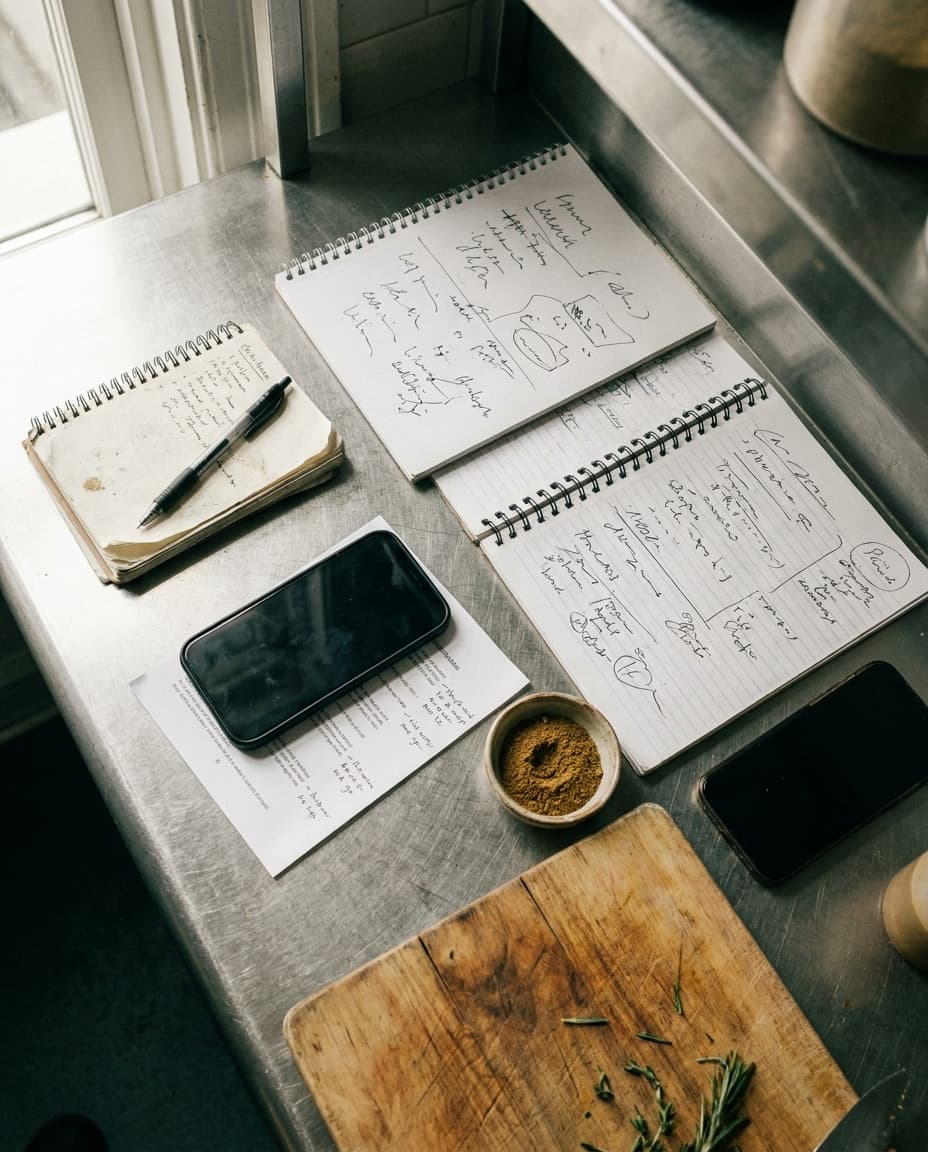
Marwell's library, if you can call it that, lives in four places. The Notes app holds his sauces and his standards — the things he writes for himself, in his own shorthand, with quantities for service rather than for one. The Leuchtturm holds his ideas, the things he is still working out. A shared Google Doc, which he edits with his chef de cuisine, holds the menu in its current draft. And the printed prep sheets, taped to the pass each morning, hold the version of the recipe that the line cooks actually use.
When something changes — and on a menu that turns over every five weeks, something is always changing — Marwell updates one of the four. Usually the Note. Sometimes the Doc. Rarely the notebook. Almost never the prep sheet, which is regenerated from scratch on Sunday by whoever is in early. 'The recipe,' he tells me, drying his hands on a side towel, 'is whichever copy I trust most this week. It moves.'
§ II.Why the consumer recipe app fails the professional.
Astrid Lindgaard, who runs pastry at a twenty-eight-seat tasting menu restaurant in Nørrebro, told me she had tried, over the years, three of the major consumer recipe apps. She uninstalled all three within a week. 'They want me to upload a photo,' she said, with a kind of weary amusement. 'They want me to rate the recipe out of five stars. They want me to tell them whether it was for a weeknight or a special occasion. I am at work. The recipe is the work.'
Her objections, broken down, were specific. The apps were too slow to capture into — a recipe she scribbled on a paper towel could be transcribed in twelve seconds; the same recipe, into a consumer app, took her over a minute of tapping through screens. The apps were too slow to retrieve from — mid-service, she could find a note in three swipes, while the apps wanted her to scroll through a tile grid of food photography. And the apps had no concept of the things she actually needed: scaling the recipe from twelve covers to forty-eight without doing the math by hand, flagging the macadamia in a financier when she had a guest with a tree-nut allergy, sharing a single canonical version with the two cooks who would actually execute it.
Beatriz Salgado, the private chef in Mexico City, made the same argument from the opposite end. She cooks for one family, four nights a week, with two children whose dietary requirements she keeps in her head and on a Post-it inside the pantry door. 'No app I have tried,' she said, 'understands that the same dish, on Tuesday, is for four people, and on Saturday, when the grandparents come, is for nine. It just shows me the recipe. The math is on me.'
The recipe is whichever copy I trust most this week. It moves.
§ III.What happens when the software finally fits.
I had brought, on each visit, a phone with Basil installed. I had not planned to demonstrate it — I am a reporter, not a salesperson — but by the third interview I found myself, almost involuntarily, opening it on the prep counter and asking the cook in front of me to try a single thing. The thing was always the same. Take a recipe you already have, anywhere, and bring it in.
Marwell pasted in the URL of an old Bon Appétit beurre blanc he had bookmarked years ago. The recipe arrived in the app — fully parsed, with ingredients on one side and method on the other — in roughly four seconds. He scaled it from four portions to twenty-four with a single tap on a number wheel, and the quantities updated in place. He added a tag for 'sauces' and another for 'staff meal,' and the recipe slotted into his library next to seventeen other things tagged the same way. He looked up at me, slightly amused, and said, 'This is the first time I have used a recipe app and not felt like I was filing a tax return.'
Lindgaard, in Copenhagen, did the harder test. She imported a financier recipe of her own — written into the Notes app three years ago, kept there ever since — by pasting the plain text into Basil. She then opened the household allergens panel, added 'tree nuts,' and watched the macadamia line in the financier flag itself in a soft amber, with a small inline note beside the ingredient. She had not asked the app to do this. The app had simply noticed. 'For a guest with a real allergy,' she said, very quietly, 'this is not a feature. This is a different kind of attention.'
§ IV.The deeper question.
What I came to understand, over the eight or so weeks of this reporting, is that the professional cook has been forced into the iOS Notes app and the Google Doc and the paper notebook not because the cook prefers chaos but because every recipe app, until quite recently, has been built for the wrong customer. They have been built for someone who wants to discover a recipe — to be sold one, really — rather than for someone who already has eight hundred and needs a place to keep them, scale them, share them, and not poison anyone with them.
The home cook with a serious library is, in this respect, the same customer as the working chef. Both have inherited recipes, captured recipes, written recipes, and modified recipes. Both need the library to behave like a tool — fast in, fast out, honest about what it knows. Neither needs another five-star rating system or a feed of trending sheet-pan dinners. The professional kitchen has been, accidentally, the leading indicator of what a recipe app should actually be.
It is half past eleven when I leave Marwell's basement. He is back at the pass, the prep sheet in his hand, the Note open on his phone, the notebook folded into his back pocket. I think, walking up Clinton Street into the cold, that within a year these four objects might collapse into one — and that he will hardly notice the collapse, because the recipe will simply be where he expects it, in the version he trusts, scaled to the night's covers, flagged for the night's allergies, ready for whoever is on garde manger to read it without asking. A salt cellar's worth of small relief. The kind of thing only the cook will know about. The kind of thing, in the end, that is the whole job.